


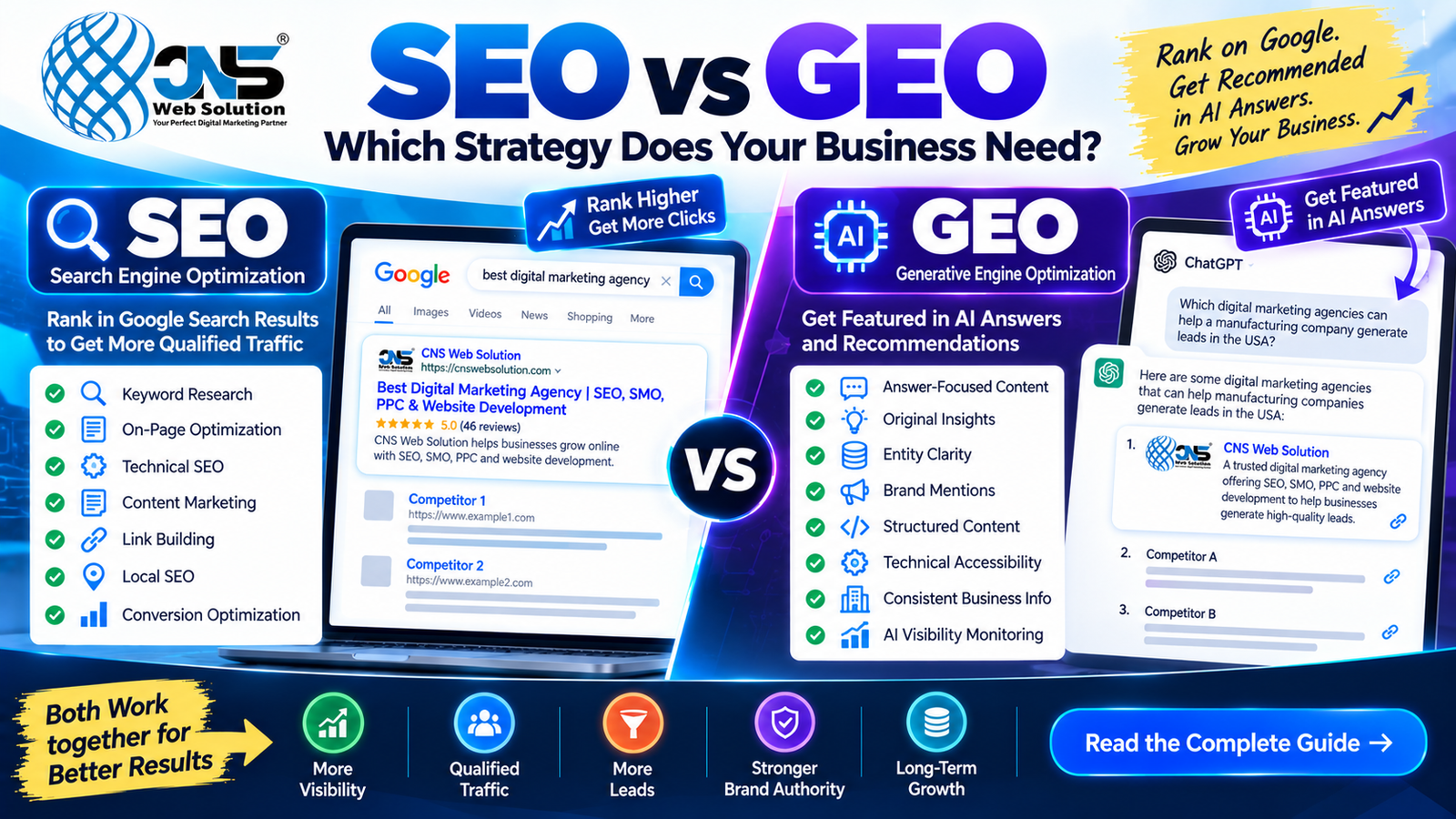
SEO vs GEO: Which Strategy Does Your Business Need?
Your website ranks on Google, but what happens when a potential customer asks ChatGPT to recommend a company like yours? Will your business appear in the answer, or will a competitor get the attention? Search behaviour is changing, and businesses need to think beyond traditional rankings. In this guide, we'll explain how SEO and Generative Engine Optimization work, where they differ, and how to choose the right strategy for your business.
What Is SEO?
Search Engine Optimization (SEO) is the process of improving your website so search engines can discover, understand, and present your pages to people searching for relevant information, products, or services.
Think about what happens when someone searches for "best digital marketing agency for small businesses." Google displays relevant results based on many signals, including relevance, quality, and usability.
A strong SEO strategy helps your business compete for those searches and attract potential customers.
What Does SEO Include?
Effective SEO typically involves:
- Keyword research: Understanding what your potential customers search for.
- On-page optimization: Improving titles, headings, content, URLs, and internal links.
- Technical SEO: Helping search engines crawl, index, and understand your website.
- Content marketing: Publishing useful articles, guides, and service pages.
- Link building and digital PR: Earning relevant mentions and links that support your website's authority.
- Local SEO: Improving visibility for location-based searches and Google Business Profile results.
- Conversion optimization: Making it easier for visitors to contact your business or purchase your services.
For example, a dental clinic in New York might target searches such as "emergency dentist in New York" or "professional teeth whitening near me."
With the right strategy, the clinic can improve its visibility among people actively looking for dental services.
Explore our SEO services at CNS Web Solution to learn more about website optimization.
What Is GEO?
Generative Engine Optimization (GEO) focuses on improving the chances that your business and website content will be discovered, understood, referenced, or cited by AI-powered search experiences.
These experiences include tools such as ChatGPT Search and Google's AI-powered search features.
Instead of simply presenting a list of links, generative AI tools can combine information from multiple sources to answer a user's question.
Imagine a business owner asking ChatGPT:
"Which digital marketing agencies can help a manufacturing company generate leads in the USA?"
The answer may include recommendations, explanations, and links to relevant websites. If your business has useful, accessible, trustworthy information, you have an opportunity to be discovered.
However, there is an important distinction: no GEO strategy can guarantee that an AI tool will mention your company.
What Does GEO Include?
A practical GEO strategy may involve:
- Answer-focused content: Clearly answering the questions your customers ask.
- Original insights: Publishing expert commentary, practical examples, research, and genuine experience.
- Entity clarity: Making your company's services, expertise, location, and industry easy to understand.
- Credible brand mentions: Building legitimate recognition through relevant publications, industry websites, and professional communities.
- Structured website content: Using descriptive headings, logical page structures, and appropriate structured data.
- Technical accessibility: Ensuring important content is crawlable and accessible to relevant search systems.
- Consistent business information: Keeping your company details, services, and expertise accurate across appropriate platforms.
- AI visibility monitoring: Checking whether relevant AI search experiences mention or cite your business.
GEO is not about inserting your company name into every paragraph or publishing hundreds of AI-generated articles. It is about giving people—and the systems helping them find information—clear, useful reasons to trust your content.
How SEO and GEO Work Together
SEO and GEO work best as complementary strategies rather than competing approaches. SEO helps your website become discoverable in traditional search results, while GEO helps improve the chances of your content being referenced in AI-generated answers. Both rely on a strong technical foundation, helpful content, and credible information about your business.
For example, if you run a digital marketing agency, SEO can help your service pages rank for searches such as “SEO agency for small businesses.” At the same time, GEO encourages you to publish clear, detailed answers to questions such as “How can a small business generate more leads through SEO?” This makes your content useful to potential customers and potentially relevant to AI-powered search experiences.
To combine both strategies, focus on these key areas:
- Create helpful content: Publish original articles, service pages, case studies, and FAQs that answer real customer questions.
- Strengthen technical SEO: Ensure search engines can crawl and index your important pages, and keep your website accessible and easy to navigate.
- Build brand credibility: Demonstrate expertise through genuine customer reviews, relevant industry mentions, expert insights, and trustworthy information.
- Structure content clearly: Use descriptive headings, concise explanations, and appropriate structured data to help systems understand your content.
- Measure performance: Track Google rankings, organic traffic, qualified leads, and conversions, while also monitoring AI mentions, citations, and referral traffic where measurable.
Neither strategy guarantees rankings or AI citations. However, combining strong SEO fundamentals with useful, trustworthy content gives your business more opportunities to reach customers across traditional search engines and AI-powered discovery platforms.
Why Businesses Should Pay Attention to AI Search
Your potential customers do not always begin their buying journey with a traditional Google search.
Some compare products using AI assistants. Others ask conversational questions, request recommendations, or use AI to narrow down their options before visiting a company's website.
For example, a manufacturer might ask an AI tool to compare suppliers by location, product specifications, certifications, and export capabilities.
If your website clearly explains these details, you give search systems and prospective customers more useful information to evaluate.
This creates several opportunities for businesses:
1. Reach Customers Earlier in Their Research
Customers often research a problem before they know which service to purchase.
A cybersecurity company, for example, can publish practical guides explaining common security risks, prevention strategies, and when professional support becomes necessary.
Useful content may help the company reach prospective customers during this early research stage.
2. Build Brand Recognition
A person may encounter your business in an AI-generated answer before visiting your website.
Even when that person does not click immediately, the mention may introduce your brand to a new audience.
That exposure is not guaranteed, so businesses should measure actual mentions, referral visits, enquiries, and conversions rather than assume every AI impression creates value.
3. Answer More Specific Questions
Traditional keyword research often identifies phrases such as "SEO agency USA."
AI-assisted research can reveal more detailed questions, such as:
- How much does SEO cost for a small business?
- What should a company expect from an SEO agency?
- How can manufacturers attract international buyers online?
- How do businesses measure visibility in AI search?
Creating genuinely helpful content around these questions can support both search visibility and the customer's decision-making process.
Can GEO Work Without SEO?
Technically, a website may be mentioned or referenced by an AI system without achieving a prominent position for every related Google keyword.
However, ignoring SEO altogether is usually a poor long-term decision.
Your website still needs accessible content, sensible navigation, useful information, and a reliable technical foundation. These elements help search systems understand your business and help visitors evaluate your services.
Google also explains that eligibility for its AI search features depends on meeting the relevant Search requirements. Following best practices does not guarantee that a page will be selected.
For businesses targeting ChatGPT Search, website accessibility matters too. OpenAI explains how publishers can manage discovery and crawler access in its official publisher and developer FAQ.
The practical lesson is simple: build a strong website first, then improve the content and signals that help your business become discoverable across relevant search experiences.
How to Build a Combined SEO and GEO Strategy
You do not necessarily need two separate marketing departments or completely different content plans. Start by connecting your existing SEO work to your AI visibility goals.
Step 1: Audit Your Website
Review your website for:
- Indexing and crawlability issues.
- Broken links and confusing navigation.
- Slow or difficult mobile experiences.
- Missing or poorly written service pages.
- Outdated information.
- Weak internal linking.
- Content that fails to answer important customer questions.
Fix critical issues before investing heavily in additional content.
Step 2: Research Customer Questions
Identify the problems your ideal customers want to solve.
Use keyword research, customer conversations, sales enquiries, support questions, and competitor analysis to build a practical content plan.
For a digital marketing agency, topics might include SEO pricing, local search visibility, lead generation, website audits, and AI search discovery.
Prioritize questions that connect naturally to the services you sell.
Step 3: Create Content That Demonstrates Expertise
Avoid publishing generic articles that repeat information already available everywhere.
Instead, include:
- First-hand experience and practical recommendations.
- Original examples and case studies.
- Accurate statistics with reliable sources.
- Clear explanations of your process.
- Specific answers to common objections.
- Author information that establishes relevant expertise.
For example, rather than publishing another generic article about increasing website traffic, explain how to identify pages that attract visitors but fail to generate qualified enquiries.
Our guide on building an SEO strategy that generates leads explores how businesses can connect search visibility with measurable business outcomes.
Step 4: Strengthen Brand Credibility
Your website should explain who you are, what you do, who you serve, and why customers should consider your business.
Support those claims with genuine testimonials, relevant case studies, accurate company information, and legitimate industry recognition.
Seek relevant editorial coverage and professional partnerships rather than purchasing spammy mentions or manufacturing reviews.
Remember, there is no guaranteed shortcut to becoming an AI-recommended business.
Step 5: Check AI Search Visibility
Test a set of relevant customer questions across the AI search tools that matter to your audience.
For example:
- Which agencies specialize in SEO for manufacturers?
- What should a small business look for when hiring an SEO company?
- Which digital marketing services help generate qualified leads?
Record whether your company appears, whether a source is cited, which competitors appear, and whether the information is accurate.
Repeat the checks periodically, recognizing that AI answers can vary between queries, locations, and sessions.
Step 6: Measure Business Results
Do not judge success only by keyword rankings or the number of AI mentions.
Track:
- Organic search impressions and clicks.
- Qualified website visits.
- AI referral traffic where analytics can identify it.
- Enquiries and consultation bookings.
- Lead quality and sales opportunities.
- Conversion rates and revenue where measurable.
Use Google Search Console and web analytics to understand performance, then connect those insights to your sales process.
Should Your Business Invest in SEO, GEO, or Both?
The right approach depends on your current position, target audience, and marketing budget.
Choose SEO as your immediate priority if:
- Your website has serious technical problems.
- Your business is not being discovered for relevant searches.
- You need to improve your service pages and organic lead generation.
- You have not yet built a consistent search optimization process.
Expand your focus to GEO if:
- Your website already has a sound SEO foundation.
- Customers increasingly use AI tools to research your industry.
- Your brand is rarely mentioned in relevant AI-generated answers.
- You want to improve discovery through multiple search experiences.
Combine both if:
- You want to build sustainable visibility across search channels.
- You operate in a competitive industry.
- You can invest consistently in technical improvements, quality content, and brand credibility.
- You want to measure both discovery and business outcomes.
For most businesses, the strongest long-term approach is to integrate GEO into an established SEO and content strategy rather than abandon traditional search optimization.
Common Mistakes to Avoid
As interest in AI search grows, businesses may encounter unrealistic promises and shortcuts.
Watch out for these common mistakes:
- Expecting instant results: Search visibility and brand recognition generally require consistent work.
- Publishing mass-produced content: Large volumes of repetitive, unhelpful pages rarely create a sustainable competitive advantage.
- Ignoring technical SEO: Useful content cannot deliver its full potential if important pages are inaccessible.
- Buying artificial brand mentions: Manipulative link-building and fabricated endorsements can damage trust.
- Believing every GEO tool: No third-party tool can guarantee access to or control over a search engine's internal ranking or AI selection systems.
- Measuring vanity metrics alone: Rankings and mentions matter only insofar as they support meaningful business goals.
The goal is not to trick an algorithm. It is to build a business presence that deserves to be discovered.
Final Thoughts: Build Visibility Where Your Customers Search
Search is evolving, but the fundamentals of successful digital marketing remain familiar: understand your audience, provide useful information, demonstrate credibility, and make it easy for customers to take the next step.
SEO helps your business compete for relevant search visibility. GEO extends your thinking to AI-powered discovery, where systems may summarize information and cite sources to answer customer questions.
Rather than treating them as competing services, combine them where it makes commercial sense.
At CNS Web Solution, we help businesses strengthen their online presence through SEO, content strategy, technical optimization, and digital marketing solutions.
Want to understand where your website stands today?
Contact CNS Web Solution to discuss your website's search visibility, content opportunities, and potential improvements. Visit cnswebsolution.com or contact our team to start a conversation about your business goals.
Better visibility starts with a clear strategy—and a website that gives customers a reason to choose you.
Frequently Asked Questions
1. Is GEO replacing SEO?
No. GEO complements SEO by focusing on discovery through generative AI experiences. Traditional SEO remains important for helping search engines crawl, understand, and rank relevant pages.
2. How long does GEO take to show results?
There is no universal timeline. AI visibility depends on factors such as content quality, website accessibility, competition, source selection, and changes in AI systems. Monitor progress regularly rather than relying on guaranteed deadlines.
3. Does GEO help a website rank higher on Google?
GEO is not a separate Google ranking factor that guarantees improved rankings. Many useful GEO practices, such as clear content, strong technical foundations, and credible information, also support good SEO.
4. Can small businesses benefit from GEO?
Yes. Small businesses can create useful expert content, explain their services clearly, maintain accurate business information, and build a credible online presence. Results depend on their industry, competition, and execution.
5. How can I check whether my business appears in ChatGPT?
Test relevant customer questions in ChatGPT Search, record whether your business is mentioned or cited, and verify the sources. Review crawler access where appropriate and track referral traffic and enquiries where measurable.
6. What is the first step toward improving AI search visibility?
Start with a website audit. Check crawlability, indexing, content quality, service-page clarity, and internal links. Then identify customer questions and create useful content that demonstrates genuine expertise.
Ready to improve your online visibility? Visit CNS Web Solution to explore a strategy tailored to your business.