


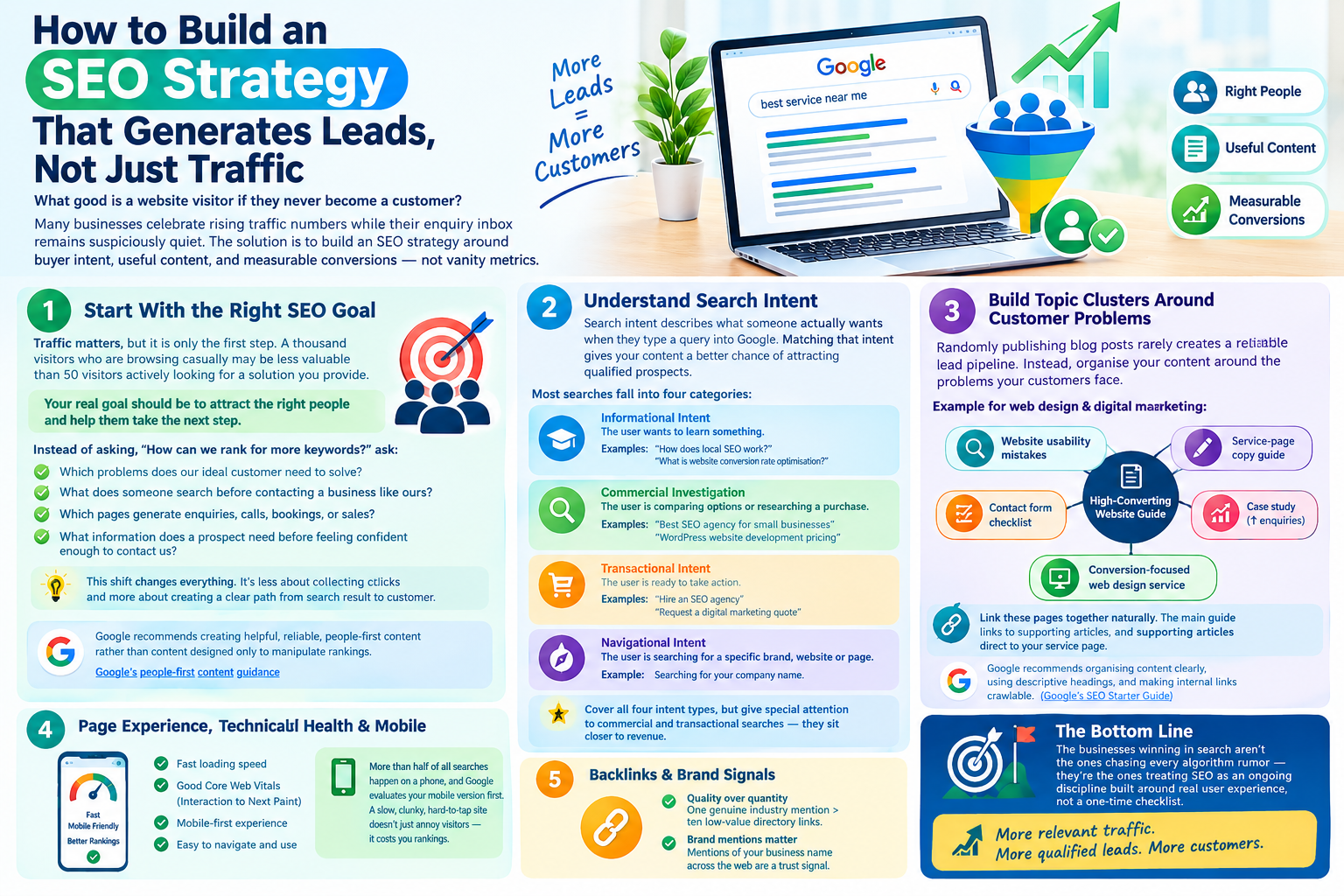
How to Build an SEO Strategy That Generates Leads, Not Just Traffic
What good is a website visitor if they never become a customer? Many businesses celebrate rising traffic numbers while their enquiry inbox remains suspiciously quiet. The solution is to build an SEO strategy around buyer intent, useful content, and measurable conversions—not vanity metrics. In this guide, you’ll learn how to turn organic search into a dependable lead-generation channel for your business.
Start With the Right SEO Goal
Traffic matters, but it is only the first step. A thousand visitors who are browsing casually may be less valuable than 50 visitors actively looking for a solution you provide.
Your real goal should be to attract the right people and help them take the next step.
Instead of asking, “How can we rank for more keywords?” ask:
· Which problems does our ideal customer need to solve?
· What does someone search before contacting a business like ours?
· Which pages generate enquiries, calls, bookings, or sales?
· What information does a prospect need before feeling confident enough to contact us?
This shift changes everything. Your strategy becomes less about collecting clicks and more about creating a clear path from search result to customer.
Google’s own guidance recommends creating helpful, reliable, people-first content rather than content designed only to manipulate rankings. That means every page should serve a genuine audience need. Google’s people-first content guidance
Understand Search Intent
Search intent describes what someone actually wants when they type a query into Google. Matching that intent gives your content a better chance of attracting qualified prospects.
Most searches fall into four broad categories:
Informational intent
The user wants to learn something.
Examples include:
· “How does local SEO work?”
· “What is website conversion rate optimisation?”
· “How often should I publish blog content?”
These searches work well for educational blog posts, guides, videos, and checklists. They may not produce an immediate enquiry, but they help you build trust and introduce your brand.
Commercial investigation
The user is comparing options or researching a potential purchase.
Examples include:
· “Best SEO agency for small businesses”
· “WordPress website development pricing”
· “SEO consultant versus agency”
Comparison pages, case studies, service explainers, and detailed buying guides can perform well here.
Transactional intent
The user is ready to take action.
Examples include:
· “Hire an SEO agency”
· “Web design company near me”
· “Request a digital marketing quote”
These visitors should land on focused service pages with a strong call to action.
Navigational intent
The user is searching for a specific brand, website, or page.
For example, someone may search for your company name after seeing your social media profile or receiving a recommendation.
A strong content plan covers all four intent types, but it gives special attention to commercial and transactional searches because they sit closer to revenue.
Build Topic Clusters Around Customer Problems
Randomly publishing blog posts rarely creates a reliable lead pipeline. Instead, organise your content around the problems your customers face.
Suppose you offer web design and digital marketing services. A useful topic cluster might include:
· A central guide about building a high-converting business website.
· A supporting post about website usability mistakes.
· A guide to writing service-page copy.
· A checklist for improving contact forms.
· A case study showing how a website redesign increased enquiries.
· A service page for conversion-focused web design.
Link these pages together naturally. The main guide can link to the supporting articles, while the supporting articles can direct readers toward your relevant service page.
This structure helps readers find the next useful resource. It also helps search engines understand the relationship between your pages. Google recommends organising content clearly, using descriptive headings, and making internal links crawlable. Google’s SEO Starter Guide explains these fundamentals in more detail.
For CNS Web Solution, internal links could point readers toward your:
Before publishing, confirm that these URLs match the live pages on your website. A broken link is not exactly the trust-building experience you want.
Create Landing Pages That Convert
Ranking well does not guarantee leads. Your landing page must give visitors a clear reason to continue.
A strong service page usually includes:
· A headline that clearly states what you offer.
· A short explanation of who the service helps.
· The business problem you solve.
· Specific benefits rather than vague promises.
· Evidence such as testimonials, case studies, certifications, or results.
· A clear next step.
· Simple contact details or an enquiry form.
· Answers to common objections and questions.
Compare these two headlines:
Weak:
“Professional Digital Solutions for Modern Businesses”
Stronger:
“Get a Fast, Mobile-Friendly Website That Turns Visitors Into Enquiries”
The second version tells the reader what they can expect and why it matters.
Keep your forms practical, too. Asking for a name, email address, phone number, and a brief description of the project may be enough. A 14-field form can make even the most motivated visitor reconsider their life choices.
Use different calls to action according to the visitor’s readiness:
· “Download the website checklist” for early-stage visitors.
· “View our recent project” for visitors evaluating your expertise.
· “Request a free consultation” for high-intent prospects.
· “Get a tailored quote” for visitors close to making a decision.
Use Content to Build Trust
People rarely hire a company after reading one page. They look for signs that you understand their situation and can deliver what you promise.
Trust-building content can include:
· Detailed case studies.
· Before-and-after examples.
· Client testimonials.
· Original research or survey findings.
· Behind-the-scenes explanations of your process.
· Author bios that demonstrate relevant experience.
· Transparent pricing guidance where appropriate.
· Frequently asked questions.
Avoid making unsupported claims such as “We guarantee first-page rankings.” Search visibility depends on many factors, and reputable SEO professionals avoid promises they cannot control.
Instead, explain your process and set realistic expectations. Show readers how you identify opportunities, improve pages, monitor performance, and connect search activity to business outcomes.
Google also encourages websites to demonstrate expertise, provide original value, and keep content accurate and up to date. Google Search Essentials provides an authoritative overview of these practices.
Track Leads, Not Vanity Metrics
You cannot improve what you do not measure. But measuring only impressions and clicks gives you an incomplete picture.
Track the journey from search to enquiry by monitoring:
· Organic sessions.
· Search impressions and click-through rate.
· Rankings for commercially valuable queries.
· Landing-page engagement.
· Form submissions.
· Phone calls.
· Consultation bookings.
· Downloads and email sign-ups.
· Qualified leads.
· Sales or revenue influenced by organic search.
Google Search Console shows how your website performs in search, including impressions, clicks, queries, and pages. Google Analytics helps you understand what visitors do after arriving on your site. Google’s guide to using Search Console and Analytics together explains how these tools complement each other.
Set up important actions as events or conversions in Analytics. For example, track when a visitor:
· Submits a contact form.
· Clicks a phone number.
· Books a consultation.
· Downloads a lead magnet.
· Sends an enquiry through live chat.
Then connect those conversions to the landing page and search query that influenced the visit whenever possible.
A page with 2,000 visits and no enquiries may need a clearer offer. A page with 200 visits and 15 qualified leads deserves more investment—even if it looks less impressive in a monthly traffic report.
Improve the Strategy Every Month
SEO is not a “publish it and forget it” activity. Search behaviour changes, competitors update their pages, and customer questions evolve.
Set aside time each month to review:
1. Which pages attracted qualified leads?
2. Which pages earned clicks but failed to generate action?
3. Which queries show strong impressions but low click-through rates?
4. Are there outdated claims, statistics, or screenshots?
5. Do internal links point users toward the next logical step?
6. Are important service pages easy to find and navigate?
7. Do mobile users receive a smooth experience?
Start with pages that already show potential. Improving a page ranking on the second page of Google can often be more practical than creating ten new articles from scratch.
You can improve an existing page by:
· Clarifying its main promise.
· Adding missing answers.
· Including relevant examples.
· Improving headings and readability.
· Adding stronger internal links.
· Refreshing outdated information.
· Making the call to action more visible.
· Adding proof that supports your claims.
Turn Search Into a Lead Engine
A lead-generating SEO strategy begins with the customer, not the keyword tool. Understand what your audience wants, create content for each stage of the buying journey, connect helpful articles to relevant service pages, and measure actions that influence revenue.
Remember the core principles:
· Target buyer intent, not just high-volume keywords.
· Build content around real customer problems.
· Create service pages that make the next step obvious.
· Use proof and expertise to reduce hesitation.
· Track conversions, qualified leads, and sales—not traffic alone.
· Improve existing pages regularly.
If your website attracts visitors but fails to create business opportunities, it may not need more content. It may need a clearer strategy. Explore the services available through CNS Web Solution, or contact the team to discuss how your website can generate more qualified leads—not just more numbers in a traffic report.