


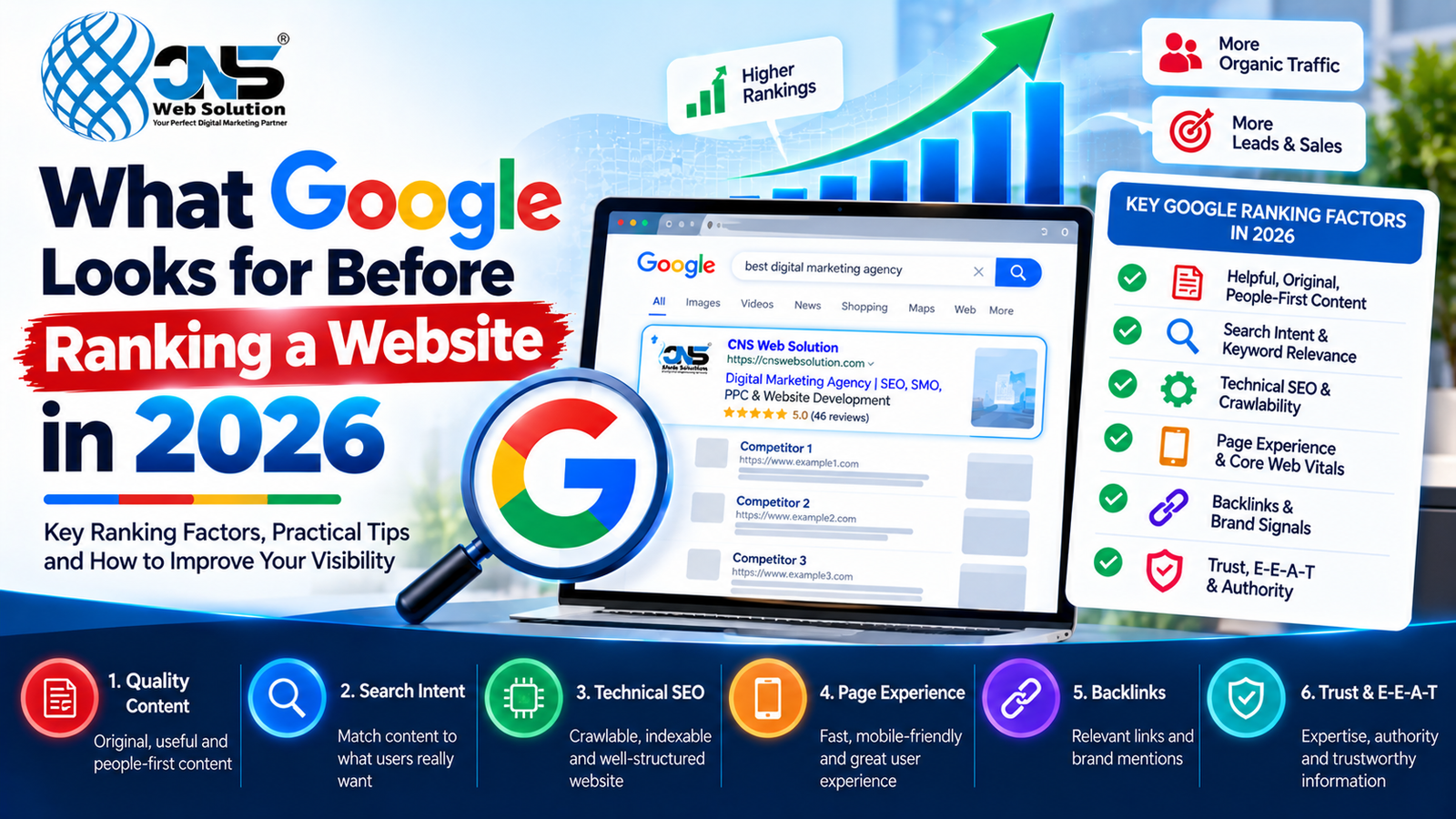
What Google Looks for Before Ranking a Website in 2026
Have you ever wondered why a competitor with a smaller website appears above your business on Google? You may have published blog posts, optimized keywords, and built backlinks, yet your website still struggles to attract visitors. The problem is that Google doesn't rank websites based on one trick or a single magic SEO score. It uses many signals and automated systems to identify relevant, useful results. Let's explore what matters most and how you can apply these principles to improve your website's visibility.
How Does Google Decide Which Websites Rank?
Google aims to present results that help people find what they need. Its systems consider many factors, including the meaning of a search query, relevance, content quality, usability, and signals that help assess a source's credibility.
There is no universal checklist that guarantees a first-page position, and Google does not publish a complete weighting formula.
According to Google's guide to Search ranking systems, its systems use multiple signals and technologies to identify relevant, useful results.
For business owners, that means successful SEO requires a combination of good content, sound technical foundations, relevant authority, and a website experience that supports visitors.
1. Helpful, Original, People-First Content
Content remains central to an effective SEO strategy. But publishing more articles does not automatically improve rankings.
Google's guidance emphasizes content that provides original information, demonstrates relevant expertise, and genuinely helps readers.
Ask yourself: if someone reads your page, will they find a complete and useful answer, or will they need to visit another website to understand the topic?
How to improve your content
- Answer the reader's main question early in the article.
- Use clear headings and logical sections.
- Include practical examples, original insights, and relevant evidence.
- Explain complicated concepts in simple language.
- Update outdated information when something meaningful changes.
- Remove repetitive paragraphs that add no value.
For example, an SEO agency could publish a generic article titled "Benefits of SEO." A more useful article might explain how a small business can identify technical problems, prioritize service-page improvements, and measure qualified leads.
The second approach gives readers practical guidance instead of simply repeating familiar marketing claims.
Read Google's official guidance on helpful, reliable, people-first content for additional recommendations.
2. Search Intent and Keyword Relevance
Your page can contain the right keywords and still fail to satisfy the searcher's needs.
Imagine someone searches for "SEO services for small businesses." They probably want to evaluate providers, understand the services available, or request a quotation. A page explaining only the history of SEO may not satisfy that intent.
Before creating or optimizing a page, determine what the user actually wants.
Common types of search intent
- Informational: The user wants to learn something, such as "What is technical SEO?"
- Commercial investigation: The user is comparing options, such as "Best SEO agency for manufacturers."
- Transactional: The user is ready to take action, such as "Hire an SEO consultant."
- Navigational: The user wants to find a particular website or brand.
Practical keyword optimization
- Research the phrases your ideal customers use.
- Group related keywords by search intent.
- Match each important topic to an appropriate page.
- Use the primary phrase naturally in the title, main heading, and relevant sections.
- Include related terms where they genuinely improve clarity.
- Write descriptive page titles and meta descriptions that encourage relevant clicks.
Avoid forcing keywords into every paragraph. Google's language systems can understand relationships between words and search queries, so natural, useful writing is a better foundation than keyword repetition.
3. Technical SEO: Make Your Website Easy to Discover
Even excellent content needs a reliable technical foundation.
Search engines must be able to discover your pages, crawl them, and understand whether they can be indexed. Technical issues can interfere with this process.
Technical elements worth checking
Crawlability and indexability: Check whether important pages are accessible to Googlebot and whether robots.txt rules, noindex directives, or other configuration issues prevent indexing.
XML sitemap: Maintain an accurate sitemap that identifies the canonical URLs you want search engines to discover.
Website structure: Organize pages logically and connect related content through descriptive internal links.
Canonical tags: Use them appropriately to identify the preferred version of duplicate or similar URLs.
Broken links and redirects: Fix broken internal links and unnecessary redirect chains that create poor navigation or crawling inefficiencies.
Mobile usability: Make sure visitors can read content, navigate menus, and complete forms comfortably on mobile devices.
HTTPS: Secure your website with HTTPS and avoid mixed-content problems.
You can start with Google Search Console, which helps you investigate indexing issues and understand how your website performs in Google Search.
A practical first step is to inspect your most important service pages before spending money creating additional content.
4. Page Experience and Core Web Vitals
Visitors should not have to fight your website to find information.
If a page takes too long to load, shifts unexpectedly while someone is reading, or responds slowly to interactions, the experience can frustrate potential customers.
Google's Core Web Vitals measure aspects of loading performance, responsiveness, and visual stability.
The current Core Web Vitals metrics are:
- Largest Contentful Paint (LCP): Measures how quickly the main content appears. A good result is 2.5 seconds or less.
- Interaction to Next Paint (INP): Measures responsiveness to user interactions. A good result is 200 milliseconds or less.
- Cumulative Layout Shift (CLS): Measures unexpected visual movement. A good result is 0.1 or less.
These thresholds are evaluated at the 75th percentile of real-user page loads, separately for mobile and desktop.
You can use Google's PageSpeed Insights to review field data where available and identify potential improvements.
Common fixes include:
- Compressing and properly sizing images.
- Reducing unnecessary JavaScript.
- Improving server response times.
- Reserving space for images and advertisements.
- Optimizing fonts and other critical resources.
Remember, excellent Core Web Vitals do not guarantee top rankings. They are part of providing a better page experience, alongside many other considerations.
5. Experience, Expertise, Authority, and Trust
Google uses a variety of signals to assess the quality and usefulness of content. Its quality guidance discusses Experience, Expertise, Authoritativeness, and Trustworthiness, commonly known as E-E-A-T.
E-E-A-T is not itself a single direct ranking factor or score. Instead, these concepts help explain qualities Google's systems aim to recognize, with trust particularly important.
How to demonstrate credibility
- Publish accurate information and correct mistakes.
- Identify authors when relevant to the subject.
- Include genuine case studies and practical examples.
- Explain your services, processes, and business clearly.
- Provide accurate contact information and company details.
- Cite reliable sources when making factual claims.
- Avoid unsupported promises and fabricated testimonials.
For example, an agency discussing SEO results should explain what work it completed, which metrics it measured, and what limitations affected the outcome.
Real evidence is more persuasive than promising every client a first-page ranking.
6. Relevant Backlinks and Brand Reputation
Links from other websites can help Google discover pages and provide context about relationships between websites. Relevant, editorially earned links can also contribute to your site's authority and reputation.
However, not every backlink is useful, and more links do not automatically mean better rankings.
Focus on earning links that make sense for your business.
Sustainable link-building ideas
- Publish original research or useful industry resources.
- Contribute expert commentary to relevant publications.
- Build relationships with legitimate industry associations.
- Create practical guides that other websites may reference.
- Participate in relevant professional communities.
- Promote useful content to journalists, editors, and industry partners.
Avoid buying links intended to manipulate rankings, automated link schemes, and large volumes of unrelated directory submissions.
For CNS Web Solution, for example, an in-depth guide to technical SEO for manufacturing websites could be more valuable than hundreds of irrelevant links from unrelated websites.
7. Internal Linking and Website Structure
Internal links connect related pages on your own website. They help visitors navigate your content and help search engines discover pages and understand their relationships.
A well-organized website also makes it easier for potential customers to move from learning about a problem to exploring your services.
An example of a useful internal linking structure
A blog post about website ranking factors could link to:
- Your on-page SEO services.
- Your SEO strategy for generating leads.
- Relevant technical SEO or content marketing resources.
- A relevant contact page when readers are ready to discuss their needs.
Use descriptive anchor text so readers know what to expect when they click.
Avoid linking every keyword to the same page or adding links that do not help the reader.
8. Freshness and Topical Relevance
Freshness matters more for some searches than others.
Someone searching for the latest Google Search update needs current information. Someone searching for the definition of a basic SEO concept may not need an article updated every week.
Review your content according to the topic and audience.
For time-sensitive pages, verify statistics, update outdated instructions, and link to current documentation. For evergreen guides, update them when meaningful new information or better explanations become available.
Do not change publication dates simply to make old content look new. The objective is to improve usefulness and accuracy, not to create the appearance of activity.
9. Local SEO and Business Information
If your business serves a particular city or region, local SEO can help customers discover your services when they search for nearby providers.
For eligible local businesses, Google Business Profile information can support visibility across Google Search and Maps.
Focus on:
- Keeping your business name, address, phone number, and hours accurate.
- Selecting relevant business categories.
- Describing your services clearly.
- Adding genuine, useful photographs where appropriate.
- Responding professionally to customer reviews.
- Creating useful location-specific pages when you genuinely serve those locations.
Avoid creating dozens of near-identical location pages for places where you do not provide meaningful services.
For companies serving multiple countries, tailor your content to the audience's language, search behavior, and market requirements rather than simply swapping country names.
10. Optimize for AI-Powered Search Without Ignoring SEO
Google's search experience continues to evolve, including features such as AI Overviews and AI Mode.
The good news is that Google states its established SEO best practices remain relevant to these features. Eligible pages still need to meet the relevant Search requirements, and there is no special optimization that guarantees inclusion in an AI-generated answer.
To prepare your website:
- Publish unique, helpful information.
- Make important pages crawlable and indexable.
- Use clear headings and logical content structure.
- Demonstrate genuine expertise.
- Support factual claims with credible sources.
- Keep important business and service information accurate.
For official guidance, read Google's documentation on AI features and your website.
Think of AI search visibility as an extension of a strong search strategy, not a reason to abandon SEO fundamentals.
11. Measure Results Instead of Guessing
You cannot improve your SEO strategy reliably if you do not know what is working.
Start by establishing a baseline using Google Search Console and your website analytics platform.
Monitor:
MetricWhat it tells youImpressionsHow often your pages appear in Google SearchOrganic clicksHow many visits arrive from organic searchSearch queriesWhich queries generate visibility and clicksIndexed pagesWhich URLs Google has indexedConversion rateWhat proportion of visitors complete a desired actionQualified leadsWhether your website attracts potential customersRevenueWhether organic marketing contributes to business growth
Do not judge progress only by average keyword positions. A page can attract valuable leads without ranking first for every target keyword, while a high-traffic page may produce very few enquiries.
Review performance regularly, investigate meaningful changes, and prioritize improvements based on business value.
A Practical SEO Checklist for Your Website
Use this checklist to organize your next round of SEO work.
- Confirm that important pages can be crawled and indexed.
- Review titles, headings, and search intent.
- Improve pages that offer little original value.
- Check mobile usability and Core Web Vitals.
- Fix broken internal links and navigation issues.
- Strengthen internal links to important service pages.
- Review backlinks and pursue relevant, legitimate opportunities.
- Update outdated information and unsupported claims.
- Verify business details and local SEO information.
- Track organic traffic, qualified leads, and conversions.
Start with the problems that affect your most important pages. You do not need to fix everything at once to begin making meaningful improvements.
Frequently Asked Questions
What are the most important Google ranking factors in 2026?
There is no definitive public ranking-factor checklist with fixed weights. Relevance, helpful content, usability, technical accessibility, and signals related to quality and credibility all matter, with their importance varying by query and context.
Does publishing more blog posts improve rankings?
Not automatically. Publishing fewer, more useful articles can be a better strategy than producing large volumes of repetitive content. Focus on your audience's needs, original value, and business goals.
Do backlinks still matter for SEO?
Links remain useful for discovery and can contribute to how Google understands pages and their relationships. Focus on relevant, naturally earned links rather than artificial link-building schemes.
How long does SEO take to show results?
There is no guaranteed timeline. Results depend on factors such as your starting position, competition, technical condition, content quality, and the work implemented. Measure progress consistently instead of relying on fixed ranking promises.
Can a technically perfect website rank first?
No. Technical health helps search engines access and understand your website, but it cannot guarantee rankings. Content relevance, usefulness, competition, and many other signals also influence results.
Does AI-generated content hurt Google rankings?
AI use alone does not determine whether content performs well. Google emphasizes quality, originality, usefulness, and compliance with its spam policies. Producing large quantities of low-value pages to manipulate rankings can violate those policies.
Conclusion: Build a Website That Deserves to Rank
Google ranking is not about finding one secret trick. It is about making your website useful to the people you want to reach and accessible to the systems that help them find information.
Start with technical health, understand search intent, publish original content, demonstrate credibility, earn relevant links, and measure the outcomes that matter to your business.
If you want to improve your website's search visibility, CNS Web Solution can help you identify practical opportunities across technical SEO, on-page optimization, content strategy, and lead generation.
Explore our SEO services and pricing, or contact CNS Web Solution to discuss your website and business goals.
Your next step is simple: identify your biggest SEO obstacle, fix it thoughtfully, and keep improving from there.