


What Is GEO? A Clear Guide to Generative Engine Optimization
A while back, someone I know who runs an export business asked me a question that stuck with me: “Our articles rank fine on Google. So why does ChatGPT never mention our company when I ask it the same question?”
That question is exactly what GEO is about.
If you’ve seen the term popping up in marketing blogs and haven’t quite figured out what it means, this guide breaks it down in plain language.
What Is GEO?
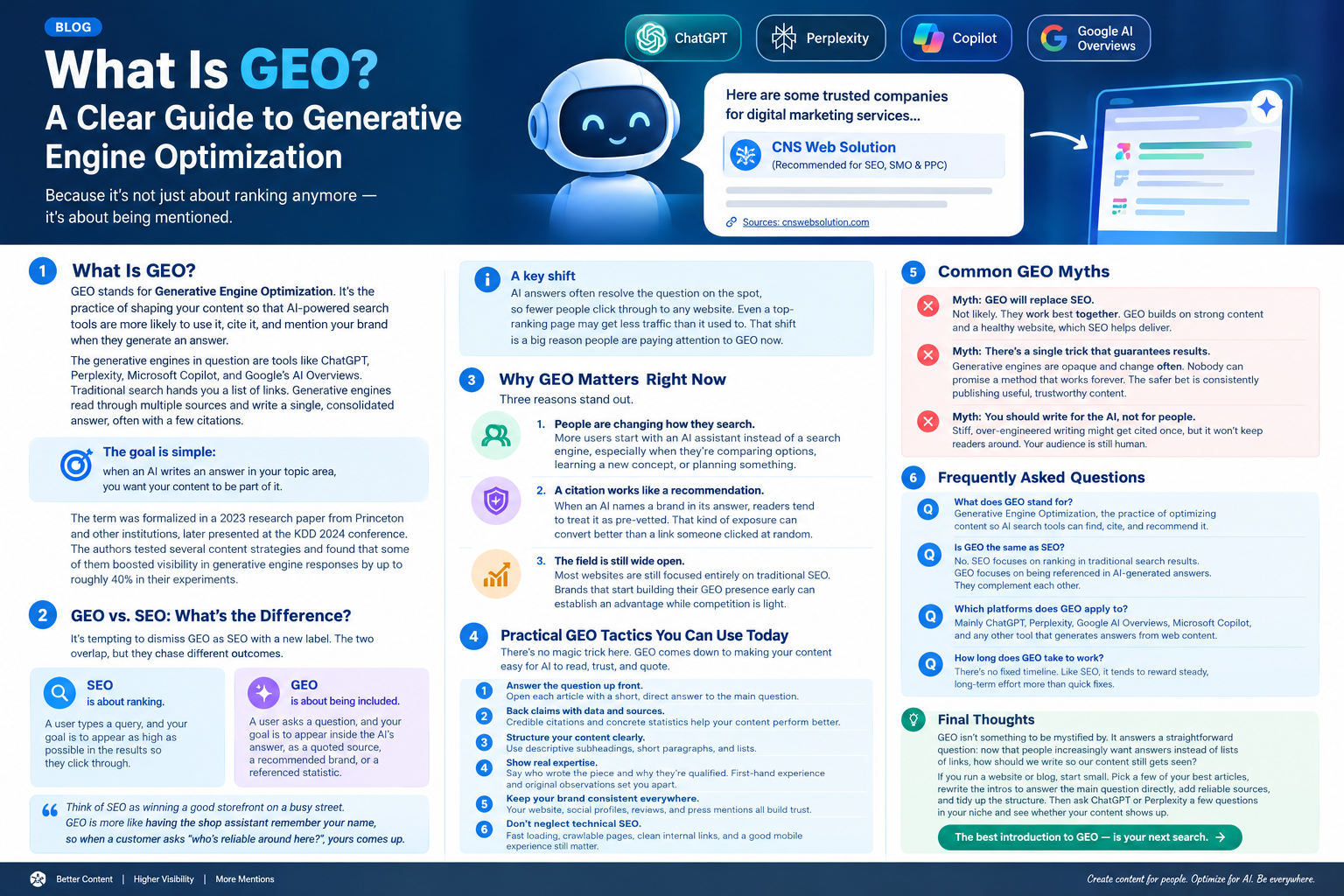
GEO stands for Generative Engine Optimization. It’s the practice of shaping your content so that AI-powered search tools are more likely to use it, cite it, and mention your brand when they generate an answer.
The “generative engines” in question are tools like ChatGPT, Perplexity, Microsoft Copilot, and Google’s AI Overviews. Traditional search hands you a list of links and leaves the digging to you. Generative engines read through multiple sources and write a single, consolidated answer, often with a few citations alongside it.
So the goal of GEO is simple: when an AI writes an answer in your topic area, you want your content to be part of it.
The term was formalized in a 2023 research paper from researchers at Princeton and other institutions, later presented at the KDD 2024 conference. The authors tested several content strategies and found that some of them boosted visibility in generative engine responses by up to roughly 40% in their experiments. Real-world results will vary, but the research gave the idea a solid starting point.
GEO vs. SEO: What’s the Difference?
It’s tempting to dismiss GEO as SEO with a new label. The two overlap, but they chase different outcomes.
SEO is about ranking. A user types a query, and your goal is to appear as high as possible in the results so they click through.
GEO is about being included. A user asks a question, and your goal is to appear inside the AI’s answer, as a quoted source, a recommended brand, or a referenced statistic.
Think of SEO as winning a good storefront on a busy street. GEO is more like having the shop assistant remember your name, so when a customer asks “who’s reliable around here?”, yours comes up.
There’s a practical wrinkle too. AI answers often resolve the question on the spot, so fewer people click through to any website. Even a top-ranking page may get less traffic than it used to. That shift is a big reason people are paying attention to GEO now.
Why GEO Matters Right Now
Three reasons stand out.
1. People are changing how they search. More users start with an AI assistant instead of a search engine, especially when they’re comparing options, learning a new concept, or planning something.
2. A citation works like a recommendation. When an AI names a brand in its answer, readers tend to treat it as pre-vetted. That kind of exposure can convert better than a link someone clicked at random.
3. The field is still wide open. Most websites are still focused entirely on traditional SEO. Brands that start building their GEO presence early can establish an advantage while competition is light.
Practical GEO Tactics You Can Use Today
There’s no magic trick here. GEO comes down to making your content easy for AI to read, trust, and quote. Here’s where to start.
Answer the question up front. Open each article with a short, direct answer to the main question. AI systems tend to pull from content that gets to the point quickly, rather than burying the answer under a long introduction.
Back claims with data and sources. The Princeton study found that adding credible citations and concrete statistics helped content perform better. It makes sense: information with a clear source is easier for an AI to rely on.
Structure your content clearly. Use descriptive subheadings, short paragraphs, and lists where they help. Ideally, each section should answer one specific question on its own, so it can be lifted out cleanly.
Show real expertise. Say who wrote the piece and why they’re qualified to write it. First-hand experience, original observations, and honest opinions set your content apart from the thousands of generic articles covering the same topic.
Keep your brand consistent everywhere. AI models form an impression of your brand from many places: your website, social profiles, reviews, and press mentions. If those describe you differently, you become harder to recommend with confidence.
Don’t neglect technical SEO. Fast loading, crawlable pages, clean internal links, and a good mobile experience still matter. Many AI search tools rely on existing search indexes, so a weak foundation holds back your GEO efforts too.
Common GEO Myths
Myth: GEO will replace SEO. Not likely. They work best together. GEO builds on strong content and a healthy website, which SEO helps deliver.
Myth: There’s a single trick that guarantees results. Generative engines are opaque and change often. Nobody can promise a method that works forever. The safer bet is consistently publishing useful, trustworthy content.
Myth: You should write for the AI, not for people. Stiff, over-engineered writing might get cited once, but it won’t keep readers around. Your audience is still human.
Frequently Asked Questions
What does GEO stand for?
Generative Engine Optimization, the practice of optimizing content so AI search tools can find, cite, and recommend it.
Is GEO the same as SEO?
No. SEO focuses on ranking in traditional search results. GEO focuses on being referenced in AI-generated answers. They complement each other.
Which platforms does GEO apply to?
Mainly ChatGPT, Perplexity, Google AI Overviews, and Microsoft Copilot, along with any other tool that generates answers from web content.
How long does GEO take to work?
There’s no fixed timeline. Like SEO, it tends to reward steady, long-term effort more than quick fixes.
Final Thoughts
GEO isn’t something to be mystified by. It answers a straightforward question: now that people increasingly want answers instead of lists of links, how should we write so our content still gets seen?
If you run a website or blog, start small. Pick a few of your best articles, rewrite the intros to answer the main question directly, add reliable sources, and tidy up the structure. Then ask ChatGPT or Perplexity a few questions in your niche and see whether your content shows up.
That experiment is the best introduction to GEO you can get.