


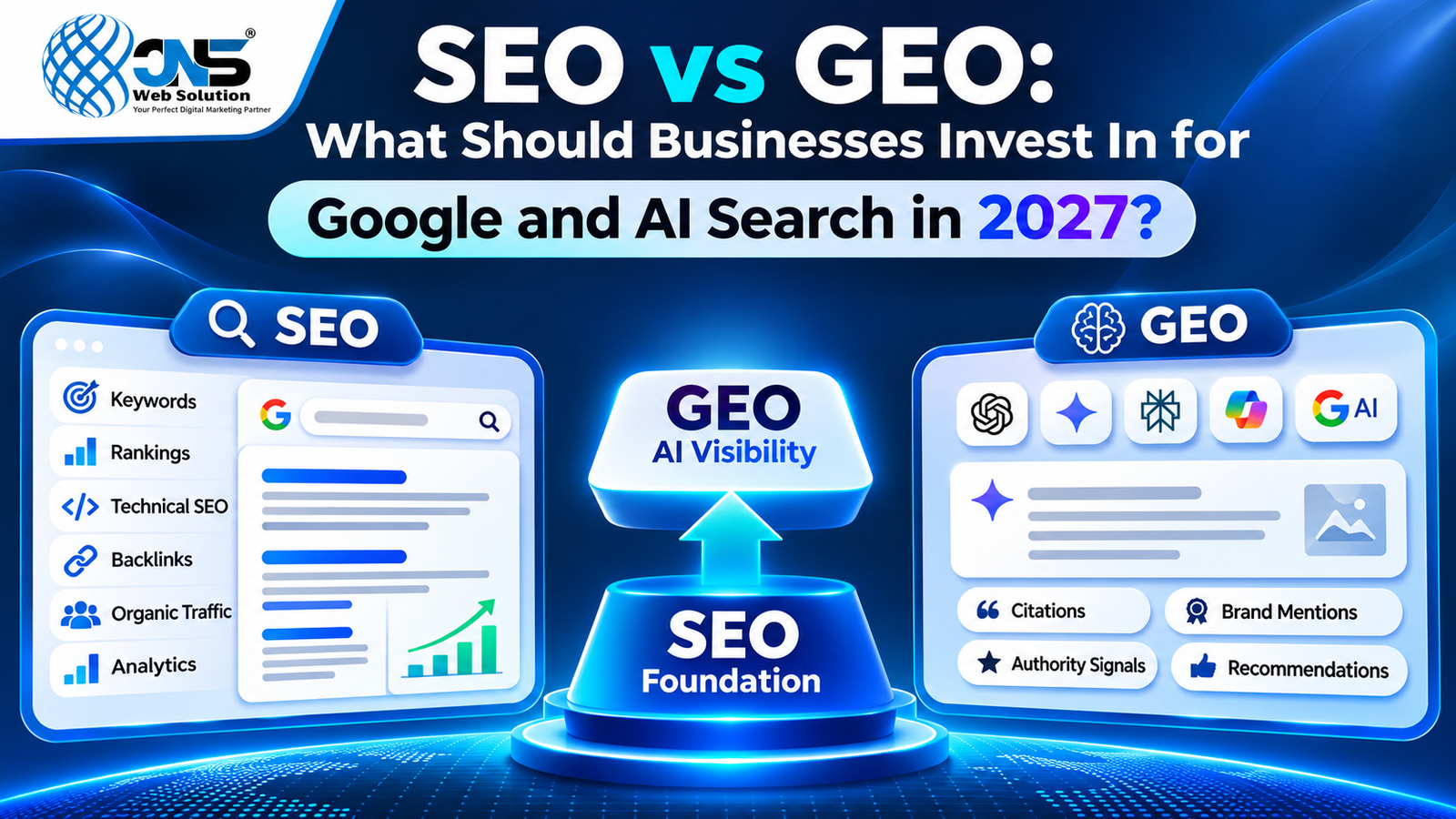
SEO vs GEO: What Should Businesses Invest in for Google and AI Search in 2027?
A few years ago, ranking on page one of Google felt like winning the internet. Today, a customer may ask ChatGPT, Gemini, Perplexity, or Google’s AI Overviews for a recommendation—and never scroll past the answer. If your business is not part of that response, you may be invisible even when your website ranks well.
That is the challenge facing every business planning its 2027 marketing budget: SEO vs GEO. SEO helps you earn visibility in traditional search results, while GEO—generative engine optimization—helps your brand get discovered, cited, and recommended inside AI-generated answers. The smartest investment is not choosing one over the other; it is building an integrated strategy where strong SEO becomes the foundation for AI visibility.
What Is SEO?
SEO, or search engine optimization, is the practice of improving your website so it ranks higher in search engines such as Google and Bing. It includes technical performance, helpful content, keyword research, internal linking, backlinks, local optimization, and user experience.
When someone searches “best CRM for small business,” “plumber near me,” or “B2B lead generation agency,” SEO helps your pages compete for those queries. The goal is simple: appear in the right search result, earn the click, and convert the visitor into a lead or customer.
SEO remains essential because organic search still delivers a substantial share of website traffic. One 2026 analysis found that organic search accounted for 16.04% of tracked traffic, even as AI-driven discovery began changing user behavior.
What Is GEO?
GEO, or generative engine optimization, focuses on making your content easy for AI systems to understand, trust, and cite. Instead of optimizing only for a blue-link ranking, GEO helps your brand appear in conversational answers across tools such as ChatGPT, Perplexity, Gemini, Copilot, and Google AI Overviews.
Think of it this way: SEO asks, “Can my page rank for this keyword?” GEO asks, “When someone asks an AI assistant for advice, will my brand be mentioned, linked, or recommended?”
A useful GEO strategy usually includes:
- Clear, direct answers near the top of each page
- Original research, statistics, case studies, and expert commentary
- Strong entity signals: consistent business name, services, locations, authors, and credentials
- Structured data and well-organized headings
- Content that answers real customer questions, not just keyword variations
- Digital PR and mentions on reputable industry websites
- Regular monitoring of AI citations, brand mentions, and referral traffic
AI platforms rely heavily on sources they can verify. In an October 2026 study of 120,000 prompts, 12.7 million answers, and 88.6 million citations across eight AI platforms, Meltwater found that Google AI Overviews alone generated more than 1 million citations to YouTube, while social platforms accounted for 22.1% of AI Overview citations. The takeaway: your visibility is no longer limited to your website—it extends across the sources AI systems use to form answers.
Why This Matters in 2027
The uncomfortable truth is that AI answers can reduce clicks. A randomized field experiment found that Google AI Mode reduced publisher click-through rates by 18.8 percentage points, while removing AI search features increased click-through rates by 8.8 percentage points. Another large-scale study found that AI Overviews reduced organic click-throughs by 38% and increased zero-click searches by 33%.arxiv+1
I have spoken with business owners who see this and panic: “If AI gives people the answer, why should I invest in content at all?” The answer is that AI needs trustworthy sources to answer confidently. If your business provides the clearest, most credible answer, AI can become a discovery channel rather than a threat.
For example, imagine a local accounting firm publishes a genuinely useful guide on GST filing deadlines, includes an accountant’s byline, links to official government resources, and answers common questions clearly. That page may rank in Google, but it is also far more likely to be used as a supporting source when someone asks an AI assistant, “What documents do I need for GST filing in India?”
SEO vs GEO: The Key Differences
The key takeaway is simple: GEO is not a replacement for SEO—it builds on it. A strong SEO foundation helps search engines and AI systems discover, understand, and evaluate your content. Businesses that combine technical SEO, high-quality content, authority, and clear brand information are better positioned to compete across both traditional search results and AI-powered search experiences. In short, SEO helps you get discovered; GEO helps your expertise become part of the answer.
1. Build a technically sound website
You cannot win AI visibility with a slow, confusing, or poorly structured website. Prioritize fast loading, mobile usability, clean URLs, secure hosting, crawlable pages, schema markup, and clear navigation.
If your site is difficult for Google to crawl, it will probably be difficult for AI systems to interpret too. Start with a professional SEO audit and technical optimization service to identify issues that limit both traditional rankings and AI readability.
2. Create answer-first content
AI systems favor content that directly answers a question, explains the context, and supports claims with evidence. Instead of writing a vague 2,000-word article stuffed with keywords, create content that solves a specific problem.
Use this structure:
- Answer the main question in the first 100 words
- Add supporting sections with clear H2 and H3 headings
- Include original examples, screenshots, checklists, or data
- Cite credible external sources
- Add an author bio with real expertise
- End with a practical next step
For instance, a web design company should not only target “website design services.” It should answer questions such as “How much does a small business website cost?”, “What makes a website convert visitors into leads?”, and “How long does SEO take to show results?”
3. Strengthen brand authority
AI engines look for signals of trust. That means your brand should be easy to recognize across the web, not just on your own domain.
Invest in:
- Detailed service pages with specific outcomes and proof
- Case studies that show real results
- Customer reviews and testimonials
- Author profiles with credentials and experience
- Guest articles, interviews, podcasts, and industry partnerships
- Consistent business information across directories and social profiles
This is especially important for local businesses. If someone asks an AI assistant for “the best digital marketing agency in Delhi,” the system needs enough consistent, credible information to understand who you are, what you do, and why you deserve consideration.
4. Optimize for questions, not just keywords
Traditional keyword research remains valuable, but 2027 content planning should also include question research. Look at the questions customers ask your sales team, the objections they raise before buying, and the language they use in reviews.
Turn those questions into content clusters:
- A main guide on the broad topic
- Supporting articles on specific subtopics
- Comparison pages
- FAQs
- Case studies
- Checklists and templates
- Video explainers with transcripts
This approach helps both humans and AI. A person gets a complete resource; an AI system gets clear, structured information it can quote or summarize.
5. Measure the right metrics
Rankings alone no longer tell the full story. Track a blend of SEO and GEO indicators:
- Organic traffic and conversions
- Keyword rankings and share of voice
- Branded search volume
- AI Overview impressions where available
- Citations and mentions in AI answers
- Referral traffic from AI platforms
- Leads, calls, form submissions, and revenue
- Content engagement, such as scroll depth and time on page
One important nuance: AI discovery inside Google may not show up as a separate referral channel because AI Overviews do not always create trackable referral sessions. That is why you should measure business outcomes, not just traffic sources.
Where Should Your Budget Go?
For most businesses entering 2027, I recommend a 70/30 starting split: roughly 70% toward foundational SEO and conversion-focused content, and 30% toward GEO, digital PR, and AI-search measurement.
Why? Because SEO creates the infrastructure that GEO depends on. A well-optimized site, authoritative content, strong internal linking, and a credible brand presence make it easier for AI systems to find and trust you.
But do not treat GEO as an afterthought. Being cited in an AI answer can matter even when it does not produce an immediate click. Seer Interactive’s analysis of 5.5 million queries found that brands cited in AI Overviews received roughly twice as many clicks as uncited brands, although cited brands still received about 38% fewer clicks than they did on searches without an AI Overview. Visibility, brand recognition, and consideration all matter before the click.
A Practical 90-Day Plan
- Audit your current visibility. Review rankings, technical SEO, content gaps, backlinks, and AI citations.
- Fix high-impact technical issues. Improve speed, mobile experience, indexing, schema, and internal links.
- Refresh your best pages. Add direct answers, credible sources, FAQs, author details, and stronger calls to action.
- Create question-led content. Build clusters around customer problems, comparisons, and buying decisions.
- Earn external credibility. Pursue relevant industry mentions, guest posts, reviews, and digital PR.
- Track both channels. Review SEO performance and AI visibility monthly, then double down on what generates leads.
The Bottom Line
The debate over SEO vs GEO is not really a debate. SEO builds the foundation; GEO helps your business show up when people ask AI for answers. In 2027, businesses that invest only in rankings may lose attention to competitors that are also cited, trusted, and recommended across AI platforms.
Your best move is to create genuinely useful content, make it easy for both search engines and AI systems to understand, and measure what actually drives revenue. If you want help building a strategy that covers Google rankings, AI Overviews, ChatGPT visibility, and lead generation, explore CNS Web Solution’s digital marketing services or read more practical growth guides on the CNS Web Solution blog.
Ready to future-proof your search strategy for 2027? Contact the CNS Web Solution team for an SEO and AI-search visibility audit, and let’s turn your website into a source customers—and AI assistants—can trust.