


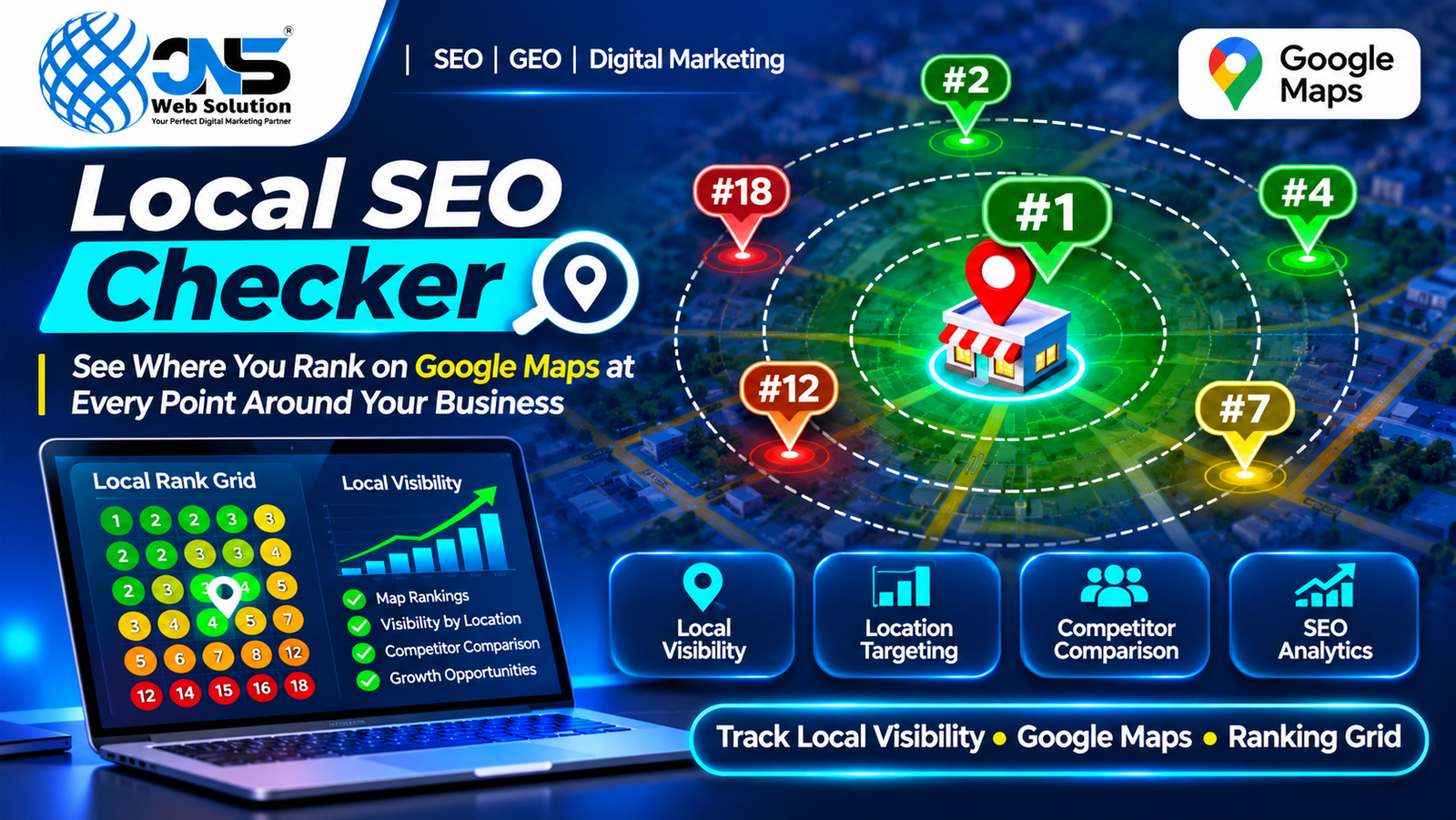
Local SEO Checker: See Where You Rank on Google Maps at Every Point Around Your Business
Have you ever searched for your own business on Google Maps and thought, “Why am I #2 when I’m sitting right here, but #15 when I move a few miles away?” That’s normal—and it’s one of the biggest problems with measuring local search visibility using a single location. A Local SEO Checker can show you how your Google Maps ranking changes from point to point, helping you understand where customers can actually find your business.
What Is a Local SEO Checker?
A Local SEO Checker is a tool or reporting system that measures how prominently your business appears in local Google Search and Google Maps for specific keywords and locations.
Instead of checking your ranking from only your office or home, a location-based checker can test multiple points around your business.
For example, imagine you own a dental clinic in Austin, Texas.
You search:
“dentist near me”
From your clinic, you might see your business in position #3.
But a potential patient five miles away could see you at #8—or not in the visible local results at all.
That difference matters.
Your local ranking isn't a single number. It can change depending on the searcher's location, the query, competition, and other local search signals.
Google itself explains that local results are primarily influenced by relevance, distance, and prominence.
Why Your Google Maps Ranking Changes From One Location to Another
This is where many business owners get confused.
You might say:
“I checked my Google Maps ranking yesterday, and my business was #1.”
Great—but where did you check it from?
Google's local results consider distance from the searcher. That means two people searching for exactly the same service can receive different local results because they are in different locations.
Think about a map like a target.
Your business sits in the center, while potential customers are scattered around it.
Some areas may have:
- Very strong visibility
- Moderate visibility
- Weak visibility
- Almost no visibility
A Local SEO Checker helps turn that invisible ranking difference into something you can actually see.
What Does a Local SEO Grid Look Like?
A local rank checker often uses a grid system.
For example:
LocationGoogle Maps PositionNear your business#11 mile north#22 miles east#43 miles south#74 miles west#125 miles northeast#18
Now you can see the real picture.
Your business may dominate the immediate neighborhood but lose visibility as the searcher moves farther away.
This information is much more useful than simply saying, “We're ranking #3.”
Why Local Ranking Matters for Small Businesses
Local search is not just an SEO vanity metric.
People use search engines and maps when they are ready to find a business, compare options, visit a location, call, book an appointment, or request directions.
Recent BrightLocal research found that 84% of consumers searched for a local business online in the previous three months. It also found that Google remains the leading starting point for local business searches.
That means your visibility around your service area can directly influence your opportunity to attract new customers.
And customers don't necessarily care that you're technically “ranking.”
They care about questions like:
- Can I find you?
- Are you close to me?
- Do you have good reviews?
- Is your business open?
- Can I call you?
- Does your service match what I need?
- Do you look trustworthy?
In fact, BrightLocal's consumer research found that proximity/address, star rating, review count, and complete business information were among the factors consumers considered when researching local businesses.
How a Local SEO Checker Helps You Understand Your Market
A good local ranking checker should help answer several practical questions.
1. Where Are You Ranking #1?
You might discover that your strongest visibility is concentrated around your physical location.
That's useful because it shows where your existing local authority is strongest.
2. Where Are You Losing Visibility?
Perhaps you're ranking well in the north side of your city but poorly in the south.
That could indicate an opportunity for:
- Location-specific content
- Better local relevance
- Citation improvements
- Stronger review signals
- Better landing pages
- More local authority
3. Which Keywords Perform Best?
You might rank well for:
“dentist near me”
but poorly for:
“cosmetic dentist [city]”
or:
“emergency dentist [city]”
A rank grid can help identify these differences.
4. How Are Your Competitors Performing?
Your competitor may not be beating you everywhere.
They could dominate certain neighborhoods while you dominate others.
That's a much more useful competitive insight than simply checking their Google Business Profile.
The Three Major Factors Behind Local Rankings
Google says local results are primarily based on relevance, distance, and prominence.
Relevance
Does your business actually match what the customer is searching for?
Your Business Profile should clearly communicate:
- What your business does
- Your primary category
- Your services
- Your location
- Your business information
The more accurately Google can understand your business, the easier it can match your profile with relevant searches.
Distance
Distance is straightforward—but surprisingly important.
A searcher located one mile from your business and another searcher located ten miles away may not see identical local results.
That's why checking rankings from multiple geographic points gives you a more realistic picture.
Prominence
Prominence is about how well-known and authoritative your business appears to be.
Google says prominence can be influenced by information such as links and reviews.
This is where your broader marketing strategy becomes important.
Your local visibility can benefit from:
- Positive customer reviews
- Relevant local links
- Strong website content
- Accurate business information
- Citations
- Local PR
- Consistent business details
Your Google Business Profile Is Still Essential
Before worrying about sophisticated ranking reports, make sure your Google Business Profile is properly managed.
Google recommends keeping business information complete and accurate, responding to reviews, and adding photos and videos.
Start with the basics:
- Correct business name
- Correct primary category
- Accurate address
- Correct phone number
- Updated business hours
- Relevant services
- High-quality photos
- Regular review management
- Accurate website URL
Small details matter.
Imagine searching for a business and seeing an outdated phone number or incorrect opening hours. Would you call?
Probably not.
Your customers won't either.
Don't Forget Your Website
Google Maps visibility doesn't exist completely separately from your website.
Your website helps establish what your business does, which locations you serve, and what information Google can understand about your organization.
Google recommends SEO practices that help search engines understand your website and its content.
For local businesses, this can include:
- Location pages
- Service pages
- Clear contact information
- Local keyword targeting
- Internal linking
- Mobile optimization
- Relevant local content
- Structured data
Google's documentation also explains how LocalBusiness structured data can communicate information such as business details and opening hours to search engines.
A Simple Local SEO Ranking Audit
Want to understand your current local visibility?
Start with this process.
Step 1: Choose Your Important Keywords
Don't track 100 random keywords.
Start with the searches that can generate customers.
For example, a plumber might track:
- plumber near me
- emergency plumber
- plumber [city]
- water heater repair [city]
- drain cleaning [city]
Step 2: Choose Your Service Area
Identify the geographic area where you actually want customers.
This could be:
- 1 mile
- 3 miles
- 5 miles
- 10 miles
- Multiple cities
- Multiple service areas
Step 3: Build a Local Ranking Grid
Check your visibility from different points across your service area.
You may discover something surprising.
Perhaps your business is #1 downtown but #10 in a nearby suburb.
That's not a failure.
It's a data point.
Step 4: Compare Competitors
Look at which competitors consistently appear in the areas where you don't.
Ask:
What are they doing that we're not?
Step 5: Improve the Weak Areas
Use the data to decide what needs attention.
Don't blindly build backlinks or publish dozens of pages.
Fix the actual weaknesses first.
Local SEO vs. Traditional Rank Tracking
Traditional SEO tracking often asks:
“What position is my website ranking for this keyword?”
Local SEO needs a slightly different question:
“Where is my business visible for this keyword across my service area?”
That's a major difference.
A business can rank #1 in one neighborhood and #9 in another.
So a single ranking report can hide the real situation.
How CNS Web Solution Can Help
At CNS Web Solution, we approach local visibility as a business-growth problem rather than simply a ranking-number problem.
Our Local SEO work includes Google Business Profile optimization, local citations, regional keyword targeting, local business schema, competitor analysis, location optimization, and performance tracking.
We also combine traditional search optimization with newer SEO, GEO, and AEO strategies when appropriate, helping businesses build visibility across search and emerging AI-driven discovery channels.
You can explore our Local SEO services to see how we approach local search optimization.
If your business also needs broader search optimization, take a look at our AI SEO services.
Frequently Asked Questions
Is Google Maps ranking the same everywhere?
No.
Local search results can vary based on the searcher's location and other ranking signals. Google specifically identifies relevance, distance, and prominence as major factors in local ranking.
Why does my business rank #1 when I search but my customer can't find it?
Your search location may be different from your customer's location. Local results can change geographically, which is why grid-based tracking is useful.
Can I pay Google to rank higher in Maps?
Google states that there is no way to request or pay for a better organic local ranking.
Paid advertising is different and is labeled as advertising.
How often should I check local rankings?
For an actively managed local SEO campaign, monitoring monthly is a reasonable starting point. Businesses in highly competitive markets may benefit from more frequent monitoring.
Do reviews affect local visibility?
Reviews are one of the signals associated with local prominence. Google recommends engaging with customer reviews, while broader local-search research also identifies reviews as an important factor in consumer decision-making.
Final Thoughts: Stop Asking “Where Do I Rank?” and Ask “Where Do I Win?”
Your Google Maps ranking isn't a single fixed number.
It is a geographic picture.
One customer may see you at #1. Another may see you at #8. Someone farther away may not see you in the visible results at all.
That's why a Local SEO Checker can be so valuable. It helps you move beyond screenshots and guesswork and understand where your business is actually visible across the market you serve.
The goal isn't to obsess over every ranking position.
The goal is to identify your strongest areas, find the gaps, understand your competitors, improve your local presence, and ultimately turn search visibility into real calls, visits, leads, and customers.
Want to know where your business actually ranks across Google Maps? Contact CNS Web Solution for a local visibility audit and discover where you're winning—and where there's room to grow.