


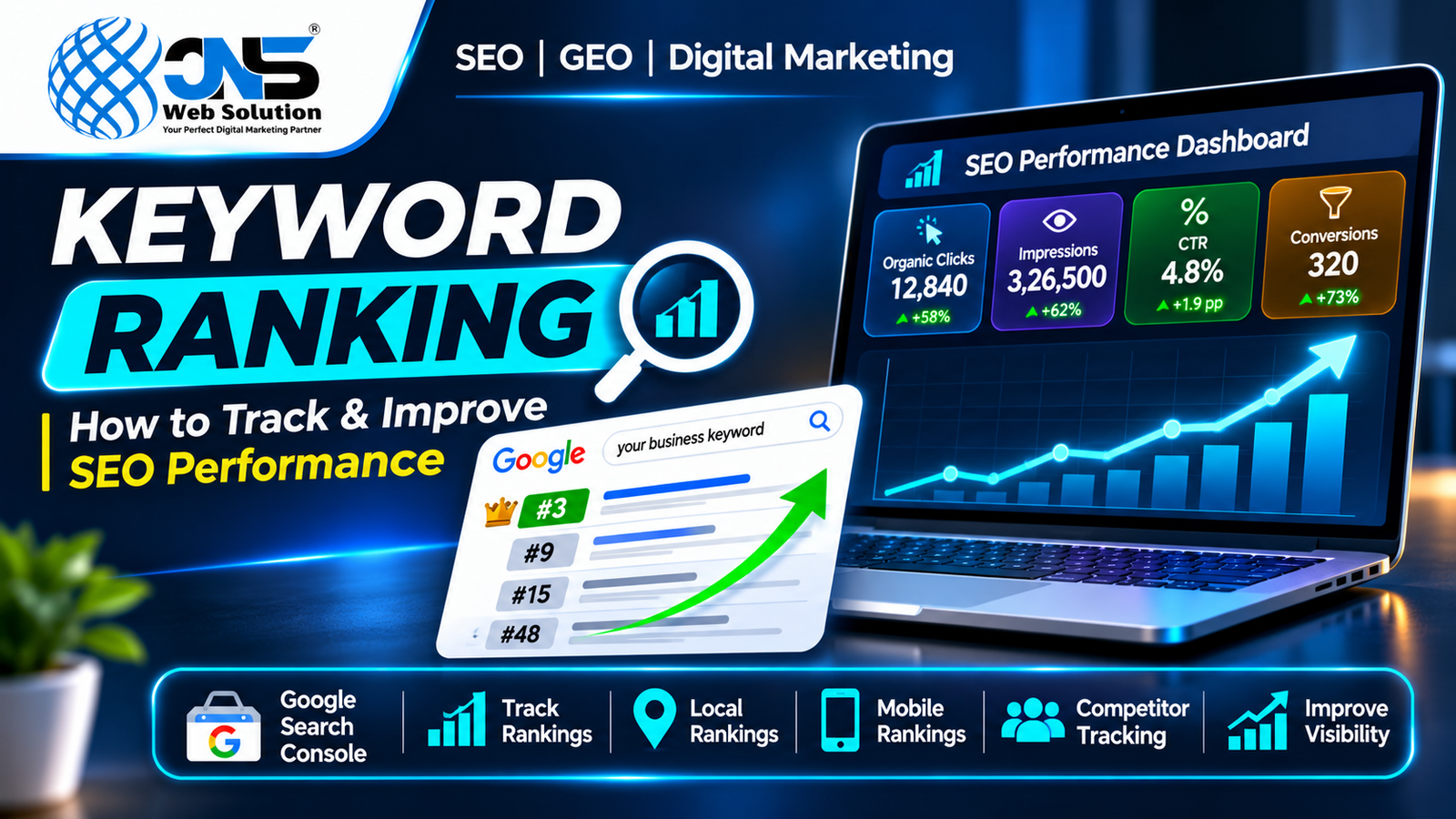
Keyword Ranking: How to Track and Improve SEO Performance
You can have a beautiful website, publish helpful content every week, and still wonder, “Why am I not getting enough customers from Google?” The answer often starts with your keyword rankings. If you don't know which keywords are bringing visibility, where your pages rank, or why rankings are moving up and down, you're making SEO decisions without a clear picture of what is working. In this guide, we'll explain how to track keyword rankings, understand SEO performance, and turn ranking data into a practical growth strategy.
What Is Keyword Ranking?
Keyword ranking refers to the position of a webpage in search engine results for a particular search query.
For example, suppose you run a dental clinic in California and your website targets:
“best dentist in Irvine”
If your page appears in position #3 on Google, your keyword ranking is #3.
Another page might rank #15 for the same keyword.
The higher your page appears in relevant search results, the more opportunities you have to attract organic visitors.
But here's the important part: ranking is not the same as business success.
A #1 ranking for a keyword nobody searches may generate almost no business. A #5 ranking for a highly commercial keyword could generate dozens of qualified leads.
That's why smart SEO tracking looks beyond rankings alone.
Why Keyword Ranking Matters for SEO
Keyword rankings help you understand whether your SEO strategy is moving in the right direction.
Tracking rankings can help you:
- Measure SEO progress
- Identify winning pages
- Discover declining keywords
- Find new ranking opportunities
- Monitor competitors
- Understand search visibility
- Prioritize content updates
- Identify technical or algorithm-related problems
- Connect SEO performance with leads and conversions
Imagine you started an SEO campaign six months ago.
Before optimization:
“HVAC repair Austin” — #48
After six months:
“HVAC repair Austin” — #9
That's a meaningful improvement.
You're much closer to the top of the search results, where potential customers are more likely to discover your company.
Don't Track Just One Keyword
One of the biggest SEO mistakes is focusing on a single keyword.
Let's say you're an SEO agency.
You might track:
“SEO agency”
But your potential customers could search for:
- SEO company near me
- SEO agency for small businesses
- local SEO services
- Google Maps SEO
- SEO consultant
- technical SEO agency
- ecommerce SEO services
- GEO optimization services
Each keyword represents a different search intent.
A strong keyword strategy tracks a group of relevant keywords, not just one phrase.
Understand Search Intent Before Tracking Rankings
Not every keyword has the same purpose.
Search intent generally falls into several categories.
Informational Intent
The user wants information.
Examples:
- What is SEO?
- How does keyword ranking work?
- How to improve Google rankings
These keywords are excellent for educational content.
Navigational Intent
The user wants to find a particular website or brand.
Examples:
- CNS Web Solution
- Google Search Console
- Semrush
Commercial Investigation
The user is researching before making a decision.
Examples:
- Best SEO agency for small business
- SEO tools comparison
- Local SEO agency reviews
Transactional Intent
The user is ready to take action.
Examples:
- Buy SEO services
- Hire an SEO agency
- Local SEO services pricing
Your keyword tracking should include a healthy mix of these intents.
How to Track Keyword Rankings
There are several ways to monitor keyword performance.
1. Google Search Console
Google Search Console is one of the most valuable free resources for understanding how your website performs in Google Search.
It can show:
- Queries
- Clicks
- Impressions
- Average position
- Click-through rate
The important thing to remember is that Search Console's average position is not necessarily the same thing as a fixed ranking for every user.
Search results can vary based on location, device, query context, personalization, and other factors.
2. Dedicated Rank Tracking Tools
Professional SEO platforms can track keyword positions over time and provide additional insights.
For example, tools such as Semrush, Ahrefs, and other rank-tracking platforms can help monitor:
- Desktop rankings
- Mobile rankings
- Local rankings
- Competitor rankings
- SERP features
- Ranking history
- Keyword movements
These tools are particularly useful when managing SEO campaigns across multiple websites or countries.
3. Google Search Manually
Manual searches can be useful for quick checks, but don't rely on them as your primary tracking system.
Why?
Because what you see may not be exactly what another person sees.
For local SEO, this becomes even more important.
A business may rank very well near its physical location but have weaker visibility several miles away.
Track Keyword Ranking by Location
If your business serves a specific geographic area, location-based tracking becomes essential.
For example, an HVAC company in Dallas might rank:
- #2 near its office
- #5 in another neighborhood
- #9 several miles away
- #18 on the edge of its service area
So asking:
“What is our Google ranking?”
is sometimes the wrong question.
A better question is:
“Where are we visible, and where are we losing visibility?”
This is especially important for local businesses competing in Google Maps and local search.
What Causes Keyword Rankings to Go Up and Down?
SEO rankings are not static.
It's normal to see movement.
Some common causes include:
Algorithm Changes
Search engines continually improve how they evaluate and rank content.
A ranking change doesn't automatically mean something is wrong with your website.
Competitor Improvements
Your competitors may publish better content, earn stronger links, improve their websites, or increase their local authority.
SEO is competitive.
Your website doesn't rank in isolation.
Content Changes
Updating or removing important content can affect rankings.
Even small changes to a high-performing page should be monitored.
Technical SEO Problems
Issues such as:
- Broken links
- Crawling problems
- Slow pages
- Poor mobile usability
- Incorrect canonical tags
- Indexing problems
can affect organic visibility.
Search Intent Changes
Sometimes Google changes which type of content it considers most useful for a query.
For example, a keyword that previously returned blog articles might increasingly show service pages, videos, local results, or product pages.
Your content needs to match the intent behind the query.
How to Improve Your Keyword Rankings
Tracking rankings is only half the job.
The real value comes from knowing what to do with the data.
1. Improve Pages Ranking in Positions 4–15
This is one of the best opportunities in SEO.
If a page is already ranking on page one or near page one, it may need targeted improvements rather than a completely new strategy.
Review:
- Search intent
- Content depth
- Page structure
- Internal links
- Title tag
- Meta description
- Supporting keywords
- Original insights
- User experience
Sometimes moving a page from #11 to #5 can create a meaningful increase in organic visibility.
2. Strengthen Internal Linking
Internal links help users and search engines discover related content.
Suppose you have an article about local SEO.
You can link naturally to related pages about:
- Google Business Profile optimization
- Technical SEO
- Keyword research
- Local SEO services
- SEO audits
Use descriptive anchor text rather than generic phrases like “click here.”
3. Update Existing Content
You don't always need to publish another article.
Sometimes your existing content already has authority but needs improvement.
Look for:
- Outdated statistics
- Missing sections
- Weak examples
- Old screenshots
- Broken links
- Search-intent gaps
- Missing FAQs
A thoughtful update can make an existing page more useful.
4. Build Relevant Authority
Backlinks can help establish authority when they come from relevant, trustworthy websites.
Focus on quality rather than simply collecting large numbers of links.
Good opportunities include:
- Industry publications
- Business directories
- Local organizations
- Partner websites
- Digital PR
- Expert contributions
- Original research
Avoid treating backlink quantity as the only SEO KPI.
5. Improve CTR
Suppose your page ranks #5 but receives fewer clicks than expected.
Your title and search-result presentation may need improvement.
Test clearer titles that communicate the benefit of the page.
For example:
Instead of:
SEO Services
Try:
SEO Services for Small Businesses | Get More Organic Leads
The goal is not to manipulate users. It's to make the search result accurately communicate why your page is worth visiting.
Don't Forget GEO and AI Search
Search behavior is evolving.
People increasingly discover information through AI-powered search experiences as well as traditional search engines.
That means your SEO strategy should not focus exclusively on one ranking number.
At CNS Web Solution, we look at broader search visibility across SEO, GEO, and AEO, including whether content provides clear, trustworthy information that can be understood and referenced by modern search and AI systems.
That means creating content that is:
- Helpful
- Well structured
- Factually accurate
- Easy to understand
- Supported by credible information
- Relevant to search intent
- Clearly associated with your business expertise
The future of search isn't simply about getting one blue link to position #1.
It's about becoming a credible answer wherever your potential customers search.
Keyword Ranking Metrics You Should Monitor
Don't overwhelm yourself with hundreds of SEO metrics.
Start with a focused dashboard.
Track:
MetricWhy It MattersKeyword positionShows ranking visibilityRanking distributionShows how many keywords rank in key positionsOrganic clicksMeasures traffic from searchImpressionsShows search visibilityCTRShows how often people clickConversionsConnects SEO to business resultsTraffic by landing pageShows which pages attract visitorsCompetitor rankingsProvides market context
The most important metric for a business is usually not simply “How many keywords rank?”
It's:
“How much qualified business is SEO generating?”
Common Keyword Tracking Mistakes
Avoid these mistakes:
Tracking Too Many Irrelevant Keywords
More keywords don't automatically mean better SEO.
Obsessing Over Daily Changes
A ranking moving from #7 to #8 isn't necessarily a crisis.
Look for trends over weeks and months.
Ignoring Conversions
Traffic without leads or sales can create a misleading picture of SEO success.
Tracking Only Desktop Rankings
Mobile search is extremely important for many businesses.
Ignoring Local Search
If you operate locally, track your visibility in the geographic areas that matter to your customers.
A Practical 30-Day Keyword Ranking Improvement Plan
Want a simple starting point?
Week 1: Audit
Identify your most important keywords and current rankings.
Group them by:
- Topic
- Search intent
- Location
- Landing page
Week 2: Find Opportunities
Look for pages ranking around positions 4–20.
These pages often represent valuable optimization opportunities.
Week 3: Optimize
Improve:
- Content
- Internal links
- Search intent alignment
- Titles
- Supporting information
- Technical SEO
Week 4: Measure
Compare your new performance with your previous baseline.
Don't expect every keyword to jump immediately.
SEO is a compounding process.
Final Thoughts
Keyword ranking is one of the clearest ways to understand whether your SEO strategy is gaining visibility—but rankings should never be the final goal.
The real objective is to attract the right audience, generate qualified traffic, build trust, and turn search visibility into measurable business growth.
Track the keywords that actually matter. Understand search intent. Watch your competitors. Improve pages that already have potential. And connect your rankings with clicks, leads, and revenue.
At CNS Web Solution, we help businesses build search strategies that go beyond traditional rankings by combining SEO, local search, content optimization, and emerging GEO/AEO approaches.
Want to know why your website isn't ranking higher? Contact CNS Web Solution for an SEO audit and discover the opportunities hiding in your current keyword data.