


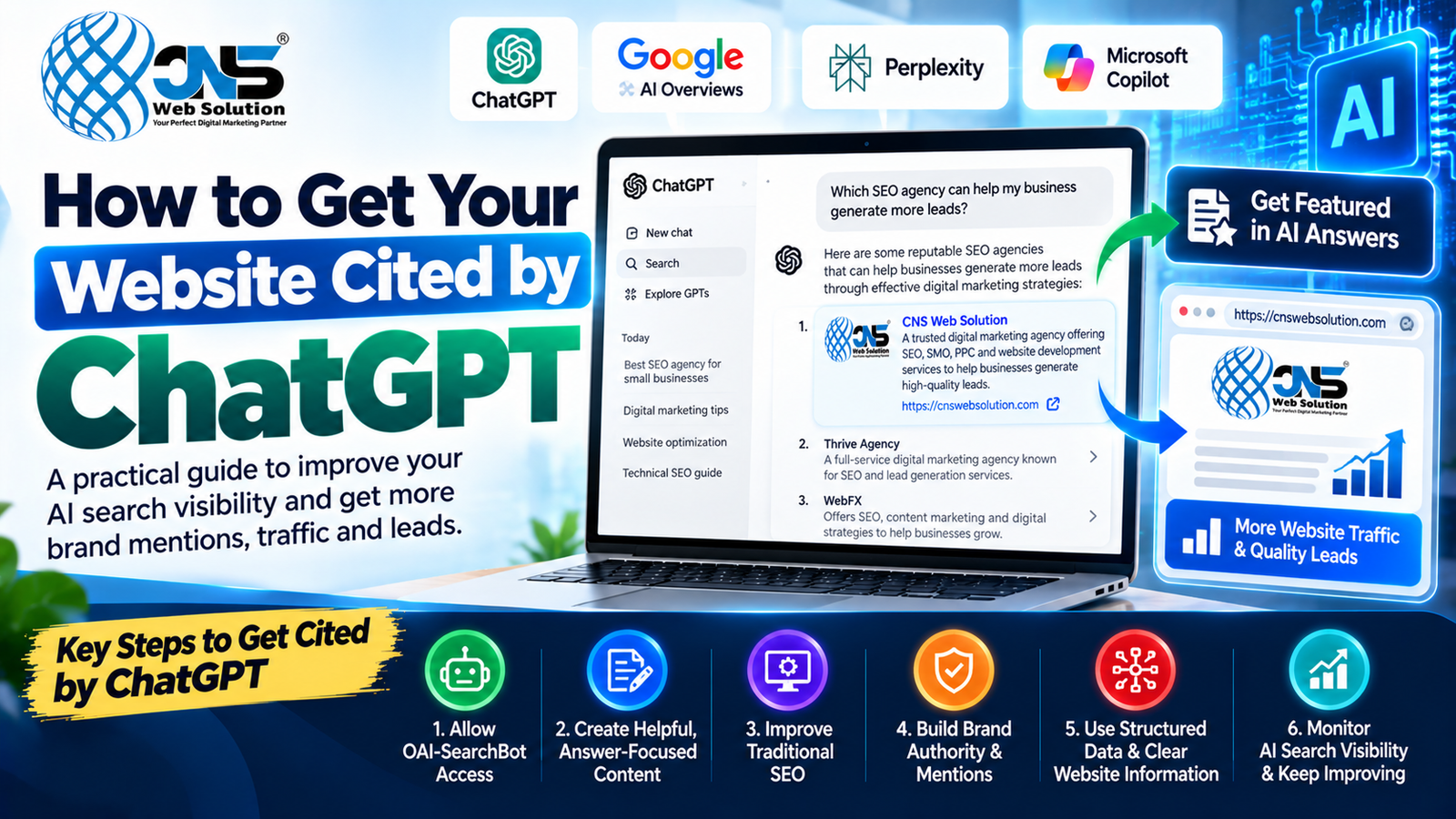
How to Get Your Website Cited by ChatGPT
Imagine a potential customer asking ChatGPT, “Which SEO agency can help my business generate more leads?” If your competitors appear in the answer but your company does not, you could be missing an opportunity to reach new customers. Traditional SEO helps people discover your website through search engines, but AI-powered search introduces another way for customers to find businesses and information. The good news? You can take practical steps to improve your website's discoverability and increase its chances of being cited in relevant AI search answers.
What Does It Mean to Get Cited by ChatGPT?
When ChatGPT Search answers a question using information from the web, it may include links to sources that support its response. A citation can direct users to a webpage where they can explore the information in more detail.
For businesses, this creates an additional opportunity to build brand awareness, demonstrate expertise, and attract relevant website visitors.
For example, someone might ask:
- Which digital marketing agencies specialize in SEO for small businesses?
- How can a manufacturing company generate more international leads?
- What should I look for when hiring an SEO consultant?
- Which technical SEO issues can prevent a website from ranking?
If your website contains useful, relevant information and can be discovered by the systems behind ChatGPT Search, it may be considered as a source.
However, no SEO technique guarantees that ChatGPT will cite or recommend your business. AI-generated answers can change depending on the question, context, available sources, and search system.
1. Make Sure ChatGPT Search Can Access Your Website
Before improving your content, check whether the relevant OpenAI crawler can access your public webpages.
OpenAI uses a crawler called OAI-SearchBot to help discover websites for ChatGPT Search. If your website blocks this crawler, your content may not be available for inclusion in ChatGPT Search answers.
How to check crawler access
Ask your web developer to review your website's robots.txt file, usually available at:
https://cnswebsolution.com/robots.txt
Check whether your rules permit OAI-SearchBot to access the pages you want discovered.
A basic example of an explicit permission rule is:
User-agent: OAI-SearchBot
Allow: /
This is an example, not a complete robots.txt file. Your existing rules, sitemap declaration, and other crawler permissions should be reviewed before making changes.
Also check whether your hosting provider, CDN, firewall, or security plugin blocks legitimate crawler requests.
Allowing the crawler is only one step. It does not guarantee that ChatGPT will index, select, or cite a particular page.
Read OpenAI's official guide to web crawlers for details about crawler access and the distinction between search discovery and model training.
2. Create Helpful Content That Answers Real Questions
One of the most practical ways to improve your chances of being cited is to publish content that answers your audience's questions accurately and thoroughly.
Think about how your customers research a service. They rarely want a page filled with marketing slogans. They want to understand a problem, compare solutions, and make a confident decision.
For example, instead of publishing a short article titled “SEO Is Important,” create a detailed guide explaining how a business can identify technical SEO problems, prioritize improvements, and measure qualified leads.
What makes content useful?
- Answer the main question early.
- Use descriptive headings that reflect the subject.
- Explain technical concepts in plain language.
- Include original examples and practical recommendations.
- Support factual claims with credible sources.
- Keep information accurate and up to date.
- Remove repetitive paragraphs that do not add value.
You should also address related questions that help readers understand the topic fully.
For instance, an article about technical SEO might explain crawling, indexing, internal linking, page speed, and common website errors.
The objective is not to write content for an AI system instead of people. It is to create information that people genuinely find useful and that search systems can understand.
3. Strengthen Your Traditional SEO Foundation
AI search visibility and traditional SEO are closely related, although they are not identical.
Your website should have accessible pages, a clear structure, useful internal links, and content that matches the questions your audience asks.
Focus on these essentials:
Keyword research: Identify the terms and questions your potential customers use when researching your services.
On-page SEO: Write descriptive page titles, clear headings, relevant content, and useful meta descriptions.
Technical SEO: Fix crawling problems, broken links, indexing issues, and confusing URL structures.
Internal linking: Connect related articles and service pages so visitors can explore relevant information easily.
Mobile experience: Make sure your website works well on mobile devices and offers straightforward navigation.
Content quality: Provide original value rather than publishing pages that repeat existing information without adding anything useful.
Google's guidance also emphasizes that established SEO best practices remain relevant to its AI-powered search experiences. See Google's official guidance on AI features and your website.
A strong SEO foundation cannot guarantee a ChatGPT citation, but it helps ensure your website is accessible and useful across multiple discovery channels.
4. Demonstrate Genuine Expertise and Credibility
Why should a reader trust your company rather than another source?
Your website should make that decision easier by explaining who you are, what you do, and what experience supports your advice.
Useful credibility signals include:
- Genuine case studies and project examples.
- Accurate author biographies.
- Relevant industry qualifications.
- Clear descriptions of your services and processes.
- Real customer testimonials.
- Original research and practical insights.
- References to reliable sources for factual claims.
For example, if you publish an article about increasing organic traffic, explain the methods you recommend and show real results only when you have evidence to support them.
Do not invent client success stories, credentials, or statistics to make your website look authoritative.
You can also strengthen your brand's online presence by contributing useful insights to relevant publications and professional communities. Prioritize genuine recognition over buying spammy links or manufacturing brand mentions.
5. Structure Your Content for Easy Understanding
Clear content structure helps readers find answers quickly and makes the relationships between topics easier to understand.
You do not need to turn every paragraph into a tiny section or use a special AI-only content format. Focus on logical organization.
Follow these content formatting practices
- Use one clear main heading for the page.
- Organize major topics under descriptive H2 headings.
- Use H3 headings for supporting questions.
- Keep paragraphs focused on one main idea.
- Use numbered steps for instructions.
- Use tables when comparing options.
- Define abbreviations and technical terms.
- Add relevant internal and external links.
For example, a page titled “How to Improve Local SEO” could include sections about Google Business Profile, local landing pages, customer reviews, local keyword research, and performance measurement.
Add structured data when it accurately describes the visible content and is appropriate for the page. Structured data can help systems interpret certain information, but it does not guarantee AI citations or special placement.
6. Publish Original Information Instead of Generic AI Content
AI tools make it easier to produce content quickly. But publishing more pages is not automatically a winning strategy.
Imagine two agencies publishing articles about technical SEO. The first repeats generic advice found across hundreds of websites. The second explains common technical problems, shares verified project examples, and provides a practical troubleshooting checklist.
The second article gives readers something more distinctive.
To make your content more valuable:
- Add first-hand experience where available.
- Include original examples or research.
- Explain why a recommendation works and when it may not.
- Verify every statistic and factual claim.
- Update content when important information changes.
- Have a knowledgeable person review technical material.
AI can assist with brainstorming, outlining, and editing, but review the final content carefully.
Google's guidance on generative AI content emphasizes accuracy, quality, relevance, and added value. Using AI is not automatically a problem; producing large volumes of low-value content to manipulate search rankings can be.
7. Build Relevant Brand Mentions and Website Authority
Your business does not exist only on your own website. Customers may encounter your brand through industry publications, professional directories, business associations, reviews, and other reputable sources.
Build your reputation by:
- Contributing expert insights to relevant industry websites.
- Publishing original resources that others may reference.
- Earning relevant editorial backlinks.
- Maintaining accurate business profiles.
- Encouraging honest customer feedback.
- Participating meaningfully in professional communities.
For CNS Web Solution, a practical example would be publishing a useful guide to SEO for manufacturing companies and sharing it with relevant manufacturing associations or industry publications.
If editors find the guide genuinely useful, they may choose to reference it.
Do not assume that a brand mention or backlink automatically results in an AI citation. These activities help establish a credible online presence, but AI source selection remains outside your control.
8. Create Content Around Specific Customer Questions
Broad keywords are useful, but specific questions can reveal what potential customers actually need.
Consider a business owner researching SEO services. They might want answers to questions such as:
- How much does SEO cost for a small business?
- How can I tell whether my SEO agency is doing a good job?
- What should a technical SEO audit include?
- How long does SEO take to generate leads?
- How can a manufacturer attract overseas customers through Google?
Create helpful pages or sections that answer these questions directly.
Organize your content around meaningful topic groups rather than creating a separate, repetitive article for every minor variation of a keyword.
For example, a comprehensive guide to technical SEO could link to supporting articles about indexing, Core Web Vitals, XML sitemaps, and website architecture.
This approach helps readers explore related information and gives your website a more coherent content structure.
9. Track Whether ChatGPT Sends Visitors to Your Website
Publishing content without measuring results is like running an advertising campaign without checking whether it generates enquiries.
Use website analytics to understand whether AI search is contributing to your business.
OpenAI documents that referral links from ChatGPT Search can include the UTM parameter utm_source=chatgpt.com. Depending on your analytics setup, you may be able to identify these visits in your reports.
Track:
- Visits referred from ChatGPT.
- Landing pages receiving AI referral traffic.
- Time spent on relevant pages.
- Enquiries and consultation bookings.
- Lead quality and conversions.
- Revenue where attribution is available.
You can also manually test relevant customer questions in ChatGPT Search and record whether your company or website appears as a cited source.
Repeat your checks periodically. Answers can vary, so one test is not enough to establish consistent visibility.
Remember that analytics cannot identify every AI-assisted discovery journey. Some users may see your brand in an AI answer and later visit your website through another channel.
10. A Practical 30-Day Plan to Improve ChatGPT Visibility
If you are unsure where to begin, use this four-week plan.
Week 1: Technical checks
- Review your robots.txt file and crawler permissions.
- Check your most important pages for indexing issues.
- Review your website's internal links and navigation.
- Identify technical problems that prevent access to important content.
Week 2: Content improvements
- Identify the most important questions your customers ask.
- Improve your core service pages.
- Update outdated articles.
- Add useful examples, reliable references, and clear explanations.
Week 3: Credibility and content distribution
- Add accurate author and company information.
- Improve relevant case studies and testimonials.
- Publish an original guide or resource.
- Share useful insights through legitimate industry channels.
Week 4: Measurement and refinement
- Test relevant customer questions in ChatGPT Search.
- Record mentions, citations, and competing sources.
- Review referral traffic in your analytics platform.
- Prioritize the pages and topics that offer the greatest business value.
This plan creates a starting point, not a promise of citations within 30 days. Results depend on your website, content, competition, and how AI search systems retrieve information.
How CNS Web Solution Can Help
At CNS Web Solution, we help businesses improve their digital visibility through SEO, technical website optimization, content marketing, and search-focused strategies.
Our work can include:
- Technical SEO and crawlability audits.
- Keyword and customer-question research.
- Content optimization and internal linking.
- Website structure and on-page improvements.
- Content credibility and digital PR recommendations.
- AI search visibility checks.
- Organic traffic and lead-generation reporting.
The right priorities depend on your website's current condition and target audience. We recommend starting with an audit to identify technical barriers, content gaps, and opportunities for improvement.
Explore our SEO services at CNS Web Solution and learn how a structured strategy can support your website's visibility.
Frequently Asked Questions
Can I guarantee that ChatGPT will cite my website?
No. You can improve accessibility, content quality, and relevance, but ChatGPT determines which sources to use for each response. No agency can guarantee citations across all queries.
Does ranking on Google guarantee a ChatGPT citation?
No. Traditional search rankings and ChatGPT citations are different outcomes. Strong SEO can support discoverability, but it does not guarantee that ChatGPT will select your page.
Should I allow OAI-SearchBot in robots.txt?
If you want your public pages to be eligible for discovery in ChatGPT Search, review your robots.txt and security settings to ensure you are not unintentionally blocking OAI-SearchBot. Allowing access does not guarantee a citation.
Do I need a special AI schema or llms.txt file?
There is no universal special schema or AI-only file that guarantees ChatGPT citations. Prioritize accessible webpages, useful content, clear structure, and appropriate structured data.
How long does it take to get cited by ChatGPT?
There is no fixed timeline. Citation opportunities depend on crawler access, content relevance, competition, and how the system retrieves sources for a particular query.
Does ChatGPT referral traffic help my business?
It can. Relevant referral visits may introduce your company to prospective customers. Track enquiries, lead quality, and conversions to understand the business value.
Conclusion: Make Your Website Worth Citing
Getting your website cited by ChatGPT is not about discovering a secret trick or publishing hundreds of AI-generated articles. It is about making your content accessible, useful, credible, and relevant to the questions your customers ask.
Start with crawler access and technical SEO. Create original content that answers real questions. Demonstrate genuine expertise, build your brand reputation, and measure the results over time.
These practices can improve your opportunities for discovery across AI-powered search, but no single tactic guarantees a citation.
Ready to improve your website's SEO and AI search visibility?
Visit CNS Web Solution or contact our team to discuss a practical strategy for your business.
Let's help more potential customers discover what your business has to offer.