


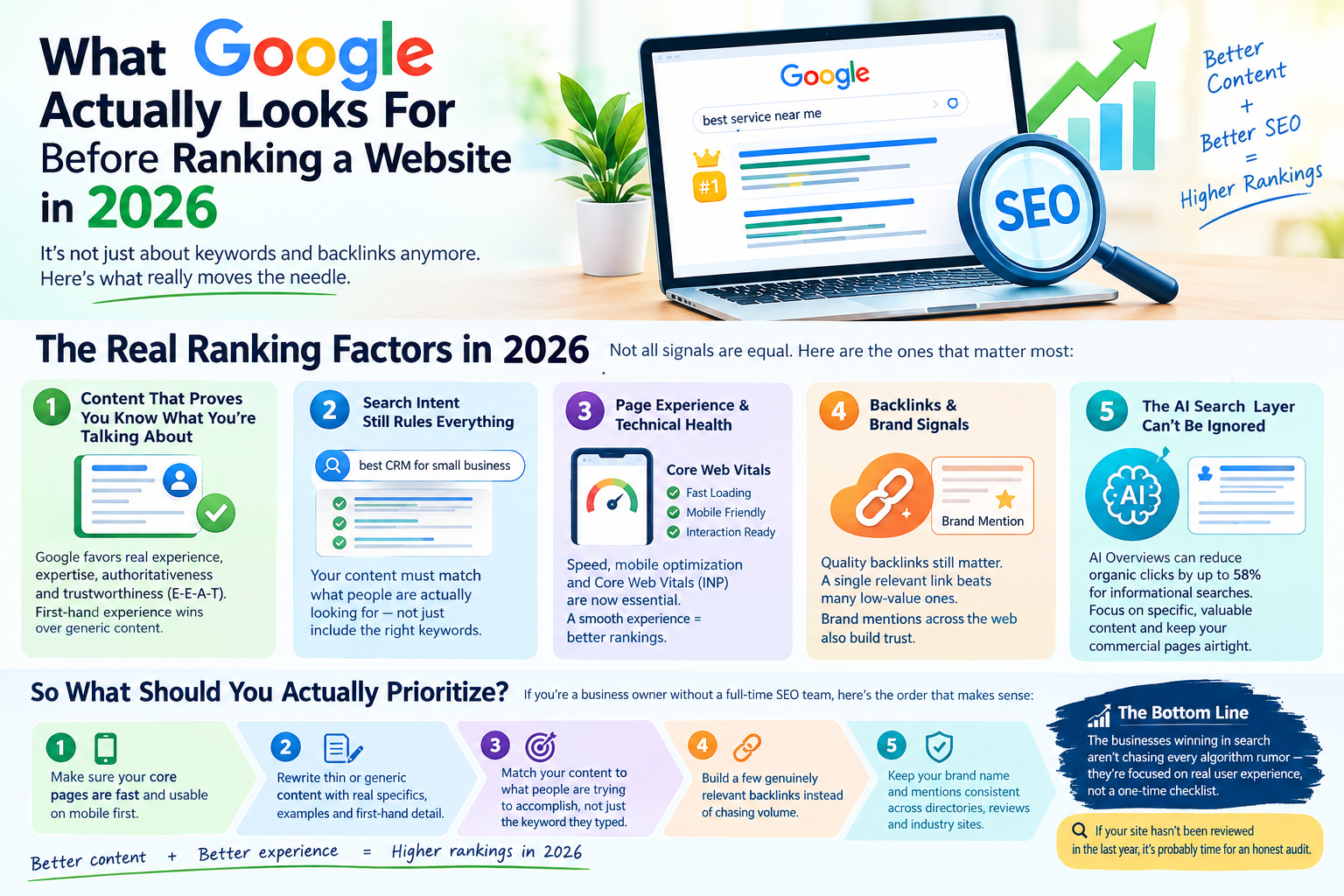
What Google Actually Looks For Before Ranking a Website in 2026
If you've ever refreshed your rankings and wondered why a competitor with a worse-looking website outranks you, you're not alone. Most business owners assume Google ranking factors in 2026 are still about stuffing the right words into a page and building a few backlinks. That approach hasn't worked in years, and honestly, it's getting further from the truth every quarter.
Google now evaluates hundreds of signals for every single search query. But here's what most SEO checklists won't tell you: not all of those signals carry equal weight. A handful of factors drive the majority of ranking outcomes, and the businesses that grow organically are the ones that focus on those first before worrying about everything else. So let's talk about what actually moves the needle right now, not what mattered in 2019.
Content That Proves You Know What You're Talking About
Google's biggest content shift over the past couple of years has centered on something called E-E-A-T — experience, expertise, authoritativeness, and trustworthiness. This framework is Google's primary content quality signal and arguably the strongest on-page factor influencing rankings today. The "experience" piece is the part most websites miss. Google now favors content written by people who've genuinely done the thing they're describing — a guide written by someone who actually installed and used a tool will beat a generic, paraphrased version, even when both pages target the same keywords and have similar backlink profiles.
What does that mean practically? If you run a local plumbing company, a blog post about fixing a leaky faucet written from real experience — with your own photos, specific brand names, and small details only a professional would know — will consistently outperform a rewritten version of ten other articles.
Search Intent Still Rules Everything
This one hasn't changed, and it probably never will. Relevance remains the single most cited ranking factor among SEO professionals, meaning your content needs to semantically match what a searcher is actually looking for, not just contain the right phrase. If someone searches "best CRM for small business," they want a comparison, not a sales pitch for one product. Mismatch that intent and no amount of Search Engine Optimization work elsewhere on the page will save you.
Page Experience and Technical Health
Here's where a lot of small business websites quietly lose ground. Core Web Vitals became table stakes in 2026, and Google shifted its interactivity metric to Interaction to Next Paint back in March 2024, which changed how sluggish, clunky pages get penalized. Translation: if your site feels laggy when someone taps a button or fills out a form, that's now measured and it's now costing you rankings.
This is also where Mobile SEO Optimization becomes non-negotiable rather than a nice-to-have. More than half of all searches happen on a phone, and Google evaluates your site's mobile version first when deciding how to rank it. A slow-loading, hard-to-tap, poorly formatted mobile page doesn't just annoy visitors — it tells Google your site isn't built for how people actually search anymore.
Backlinks and Brand Signals Haven't Gone Away
Some things really are timeless. Backlinks continue to sit near the top of what SEO experts consider most important, alongside content quality and relevance. But the quality bar has risen. Ten low-value directory links do far less for you than one genuine mention from a site in your industry. Google is also getting better at recognizing brand signals — mentions of your business name across the web, even without a link attached, are increasingly treated as a trust signal.
The AI Search Layer Nobody Can Ignore Anymore
This is the part that's genuinely new. AI Overviews have reduced organic click-through rates by as much as 58% on purely informational searches, which means click value is now concentrated more heavily on commercial and transactional queries than it used to be. If your business blog only produces general "what is X" content, you may be feeding Google's AI answers without ever getting the click.
The fix isn't to abandon informational content — it's to make it specific enough that it becomes the source Google's AI pulls from, while making sure your commercial pages (services, pricing, location pages) are airtight from an intent and technical standpoint, since that's where the traffic that actually converts still lives.
So What Should You Actually Prioritize?
If you're a business owner without a full-time SEO team, here's the order that makes sense in 2026:
- Make sure your core pages are fast and usable on mobile first.
- Rewrite thin or generic content with real specifics, examples, and first-hand detail.
- Match your content to what people are actually trying to accomplish when they search, not just the keyword they typed.
- Build a small number of genuinely relevant backlinks rather than chasing volume.
- Keep your brand name and mentions consistent across directories, reviews, and industry sites.
None of this is flashy, and that's kind of the point. The businesses winning in search right now aren't the ones chasing every algorithm rumor — they're the ones treating Search Engine Optimization as an ongoing discipline built around real user experience, not a one-time checklist.
If your website hasn't been reviewed against these factors in the last year, it's probably time for an honest audit. Rankings rarely drop because of one big mistake — they erode quietly, one outdated page at a time.