


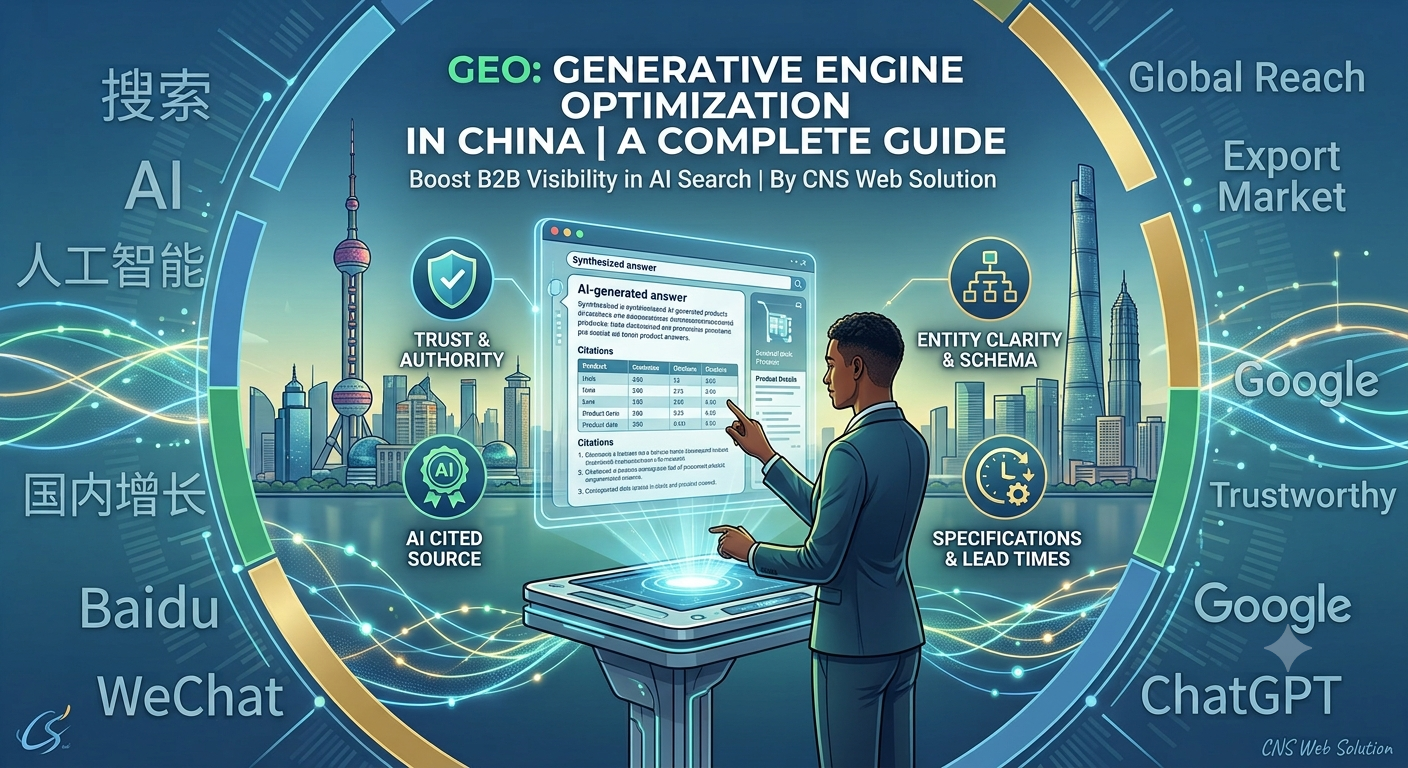
What Is GEO? A Complete Guide to Generative Engine Optimization in China
By CNS Web Solution
Imagine a procurement manager in Germany looking for a reliable CNC parts supplier. Increasingly, she does not start with ten blue links. She asks an AI assistant, reads a synthesized answer, and shortlists the two or three suppliers it mentions. If your company is not in that answer, you may never enter the conversation.
That shift is why Generative Engine Optimization China has become a serious topic for manufacturers, exporters and B2B companies. Generative Engine Optimization (GEO) is the practice of making your brand, products and expertise easy for AI-powered search systems to find, understand, trust and cite.
The business benefits are practical: visibility at the research stage of a long B2B buying cycle, stronger credibility when buyers compare suppliers, more qualified inquiries, and content assets that also strengthen traditional SEO. This guide explains what GEO is, how it differs from SEO, how China's unique digital ecosystem changes the strategy, and what to do first.
What Is Generative Engine Optimization (GEO)?
Generative Engine Optimization is the process of optimizing your content and online presence so that generative AI systems can accurately understand your business and include it in the answers they produce. These systems include AI chat assistants, AI-generated summaries inside search engines, and answer engines that cite sources.
Traditional search returns a ranked list of pages. Generative systems usually do something different: they retrieve information from multiple sources, combine it, and write a single response, sometimes with citations or links. The goal of GEO is not only to rank, but to be retrieved, understood and referenced.
The term was popularized by academic research. A 2023 paper titled GEO: Generative Engine Optimization (Aggarwal et al.) studied how content changes can affect visibility inside generative engine responses. It is a useful starting point, though the field is young and AI systems change quickly. No one can honestly promise guaranteed placement in AI answers, and you should be cautious of anyone who does.
You will also see related terms such as AI search optimization, answer engine optimization and AI search visibility. They overlap heavily. In this article we use GEO as the umbrella term.
What Is SEO, and Where Does GEO Fit?
Search engine optimization (SEO) is the work of improving a website so it ranks well in search engine results. It covers technical health, on-page content, keyword targeting, internal linking, backlinks and user experience.
GEO does not replace SEO. It builds on it. AI search systems often rely on the same foundations: crawlable pages, clear content, trustworthy sources and strong topical coverage. A site with poor technical SEO and thin content is unlikely to be a reliable source for AI answers either. Think of SEO as the foundation and GEO as the layer that makes your expertise easy for AI systems to extract, verify and quote.
GEO vs SEO: Key Differences
Goal and success. SEO aims to rank your pages in search results, and success is measured by position, clicks and organic traffic. GEO aims to get your brand cited or mentioned in AI-generated answers, and success is measured by citations, brand mentions, answer inclusion and qualified inquiries.
Queries and content. SEO usually targets short keywords with keyword-focused pages. GEO targets longer, conversational, multi-part questions, so it works best with clear answers, definitions, comparisons, FAQs and data.
Authority and technical work. For SEO, authority comes from backlinks, domain strength and relevance. GEO needs the same, plus consistent brand mentions, credible third-party sources and named expertise. Technically, SEO focuses on crawling, indexing, speed and mobile. GEO covers the same foundations and adds structured data, entity clarity and crawler access.
Measurement and timing. SEO is measured through rankings and analytics. GEO is measured through manual prompt testing, referral traffic, brand-mention tracking and the quality of inquiries. Both take time: SEO grows over months, and GEO results are also gradual because AI systems and their sources change often.
China's Digital Ecosystem: Two Different Audiences
This is where many generic GEO guides go wrong. China's internet is not a copy of the Western one, and not every international AI platform is available inside mainland China. Chinese B2B companies usually need to think about two separate audiences.
Audience 1: Buyers inside mainland China
Domestic search and discovery run on a different set of platforms:
• Baidu remains the largest domestic search engine and has added AI features, including its ERNIE-based assistant.
• WeChat is both a messaging app and a content and search ecosystem, with official accounts, mini programs and in-app search.
• Domestic AI assistants such as DeepSeek, Doubao (ByteDance), Kimi (Moonshot AI), Tongyi Qianwen/Qwen (Alibaba) and Tencent Yuanbao are widely discussed in China. Their features and sources evolve rapidly.
• Content platforms such as Zhihu, Xiaohongshu and Douyin influence research and brand perception, and can feed the wider information environment.
Hosting and compliance matter here. Websites served inside mainland China generally require ICP filing, and performance for domestic users depends on local hosting or a suitable CDN.
Audience 2: Overseas buyers
Most Chinese exporters care about this audience. Overseas buyers commonly use Google, Bing, and AI tools such as ChatGPT, Gemini, Perplexity and Microsoft Copilot, along with AI summaries inside search results. Several of these are not officially available to users in mainland China, and access can change. That does not make them irrelevant to a Chinese exporter. Your customers are the ones using them, wherever your factory is located.
The key point: do not assume one strategy fits both audiences. An exporter selling to Europe and North America needs an English-language, internationally hosted, Google-friendly presence. A company selling domestically needs Baidu, WeChat and local platform presence. Many companies need both, with separate content for each.
Examples for Chinese Manufacturers, Exporters and B2B Companies
The scenarios below are illustrative, not client case studies.
• A hardware manufacturer in Zhejiang wants overseas distributors to find it. A buyer asks an AI assistant, Who manufactures stainless steel fasteners with ISO 9001 certification? The manufacturer's site that clearly states certifications, materials, tolerances, minimum order quantities and export markets gives AI systems concrete facts to work with. A brochure-style homepage with vague claims does not.
• A textile exporter in Guangdong publishes a guide to fabric specifications, sampling timelines and compliance requirements for the EU market. Clear, practical answers are more likely to be referenced than generic marketing copy.
• A B2B machinery company that serves domestic factories builds Chinese-language content for Baidu and WeChat, with product pages, application guides and an official account. Its approach is different from an exporter's, but the principle is the same: be clear, specific and credible.
• An industrial software provider earns mentions in industry directories and trade publications, strengthening its identity as a recognized entity in its category.
Practical GEO Strategies
1. Optimize your content for answers
Write pages that answer real buyer questions directly. Lead each section with a clear, factual answer, then add detail. Useful formats include definitions, specification tables, comparisons, buying guides, process explanations and application notes. Use plain language, avoid unsupported superlatives like best or number one, and write for the buyer first.
For exporters, be specific: certifications, production capacity, lead times, quality control steps, export experience, Incoterms and target markets. Specific facts are easier for AI systems to extract and verify than slogans.
2. Build FAQ content that matches real questions
FAQs mirror how people prompt AI tools. Collect questions from your sales team, inquiry emails, WhatsApp conversations and trade show notes. Answer each concisely in two to four sentences, then link to deeper content. Place FAQs on product, category and service pages, not only on a separate FAQ page.
3. Use structured data
Structured data helps machines interpret your pages. Use schema.org markup where it genuinely applies, such as Organization, Product, FAQPage, Article, BreadcrumbList and LocalBusiness. Keep the markup accurate and consistent with visible page content. Structured data does not guarantee AI citations, but it reduces ambiguity about who you are and what you offer.
4. Strengthen technical SEO
AI systems cannot use what they cannot access. Check that your important pages are crawlable, indexable, fast and mobile-friendly. Use clean URLs, XML sitemaps and logical internal linking. Avoid hiding key information inside images, PDFs only, or JavaScript that does not render properly. Review your robots.txt and crawler settings deliberately, since different AI providers use different crawlers, and decide which you want to allow. For international buyers, consider hosting and CDN performance outside mainland China. For domestic audiences, handle ICP requirements and local speed.
5. Cite and earn authoritative sources
AI systems tend to favor content that is verifiable. Reference credible sources, such as standards bodies, government trade data, industry associations and recognized research, and make your own claims traceable: certifications, test reports, named experts and dated updates. Original material, such as your own process documentation or technical guidance, gives others a reason to cite you.
6. Build brand mentions and entity consistency
Beyond your site, AI systems learn about companies from the wider web. Keep your company name, description, address and product categories consistent across your website, LinkedIn, B2B marketplaces, industry directories, trade show listings and press mentions. Contribute expert commentary to industry publications and relevant forums. For the domestic market, maintain a professional presence on WeChat and, where relevant, Zhihu. Mentions from credible third parties support both SEO and GEO.
7. Publish bilingual content with care
Use natural, professionally edited English for overseas buyers and native Chinese content for domestic ones. Avoid machine-translated pages that read awkwardly, since unclear language makes it harder for any system, human or AI, to trust your content.
How to Measure GEO Progress
GEO measurement is still imperfect, so be realistic. Practical approaches include:
• Testing a consistent list of buyer-style prompts in relevant AI tools and recording whether your brand appears or is cited.
• Tracking referral traffic from AI platforms in your analytics where available.
• Monitoring brand mentions and branded search growth.
• Watching the quality of inbound inquiries, not just volume.
AI answers can vary by user, location, time and model version, so treat results as directional.
Common GEO Mistakes to Avoid
• Treating GEO as a trick instead of a content and credibility strategy.
• Publishing exaggerated claims that cannot be verified.
• Ignoring technical SEO.
• Using one China-wide strategy for domestic and overseas audiences.
• Assuming every international AI platform is accessible to everyone in mainland China.
• Expecting overnight results or accepting guarantees of AI rankings.
Frequently Asked Questions
1. What is Generative Engine Optimization in simple terms?
GEO is optimizing your content and online presence so AI-powered search tools can understand your business and mention or cite it in generated answers.
2. Is GEO replacing SEO?
No. GEO builds on SEO. Crawlable, well-structured, trustworthy content is still the foundation, and GEO adds answer-focused content, entity clarity and wider brand authority.
3. Do Chinese companies need GEO if they sell overseas?
Often yes. Overseas buyers increasingly use AI assistants and AI search summaries during supplier research, so exporters benefit from being clearly represented in those environments.
4. Which platforms matter for GEO in China?
For domestic audiences, Baidu, WeChat and Chinese AI assistants such as DeepSeek, Doubao, Kimi, Qwen and Yuanbao are relevant. For overseas buyers, Google, Bing, ChatGPT, Gemini and Perplexity matter, though some are not officially available in mainland China.
5. Can anyone guarantee that my company will appear in AI answers?
No. AI systems are complex and change often. Reputable providers can improve your clarity, credibility and visibility signals, but cannot guarantee specific outcomes.
Get Started with GEO and SEO Services from CNS Web Solution
If your company wants to be found by international buyers, or by customers across China's own digital ecosystem, a strong SEO foundation and a clear GEO strategy work best together. CNS Web Solution helps manufacturers, exporters and B2B companies with SEO audits, content strategy, technical optimization, structured data and AI search visibility planning.
Contact CNS Web Solution today to request a free consultation and discuss a GEO and SEO roadmap built around your target markets.
Please follow and like us: Facebook