


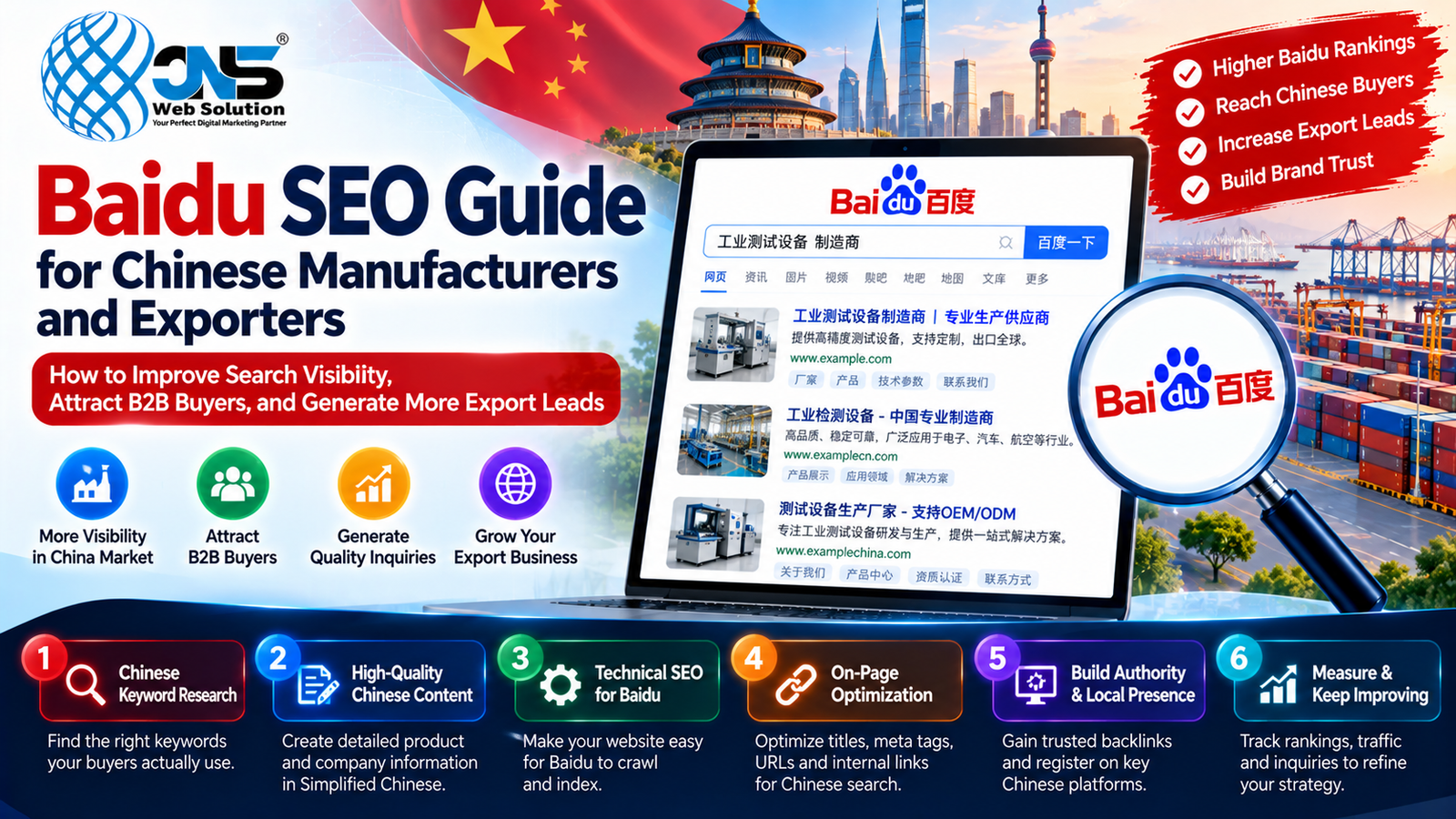
Baidu SEO Guide for Chinese Manufacturers and Exporters
How to Improve Search Visibility, Attract B2B Buyers, and Generate More Export Leads
If your manufacturing company produces high-quality products but overseas buyers struggle to find you online, your website may be missing an important opportunity. In China, optimizing for Baidu can help businesses improve their visibility among Chinese-speaking audiences and buyers researching suppliers in the Chinese market. The key is to build a website that Baidu can crawl, content that matches local search behavior, and product pages that give potential customers a reason to contact you.
What Is Baidu SEO, and Why Does It Matter?
Baidu is a major search engine in China, and its search ecosystem differs from the one many international businesses are familiar with. A strategy designed exclusively for Google may not translate directly into strong visibility on Baidu.
Baidu SEO involves optimizing your website and content to help Baidu discover, understand, index, and potentially rank your pages for relevant Chinese-language searches.
For manufacturers and exporters, this can support several business goals:
- Help potential buyers discover your products and capabilities.
- Increase visibility for product-specific and industry-specific searches.
- Build credibility with distributors, importers, and procurement teams.
- Generate more qualified inquiries through product and quotation pages.
- Support your broader digital marketing strategy in China.
The opportunity is significant. According to a report published by China's official government portal in February 2026, the country had approximately 1.125 billion internet users at the end of 2025. That figure represents the wider online market, not the number of Baidu users or potential B2B buyers, but it demonstrates the scale of China's digital economy. Read the official report on China's internet users.
1. Start With Chinese Keyword Research
One of the most common SEO mistakes manufacturers make is translating their English keywords word for word and assuming Chinese buyers use the same phrases.
Search behavior varies by industry, product, and buyer intent. A procurement manager searching for industrial equipment may use a different term from an engineer researching technical specifications.
Start by identifying the Chinese words and phrases your ideal customers actually use.
Research product-specific keywords
Suppose your company manufactures industrial testing equipment. Your keyword research might include:
- The Chinese product name.
- Product type and model.
- Technical specifications and capacity.
- Application or industry.
- Manufacturer and supplier terms.
- Wholesale, bulk purchasing, and customization terms.
- Export and OEM-related terms where relevant.
For example, a company selling industrial testing machines could investigate Chinese search phrases related to the equipment's name, testing application, accuracy, and manufacturer status. Have a fluent Chinese-speaking specialist validate the terms before publishing them.
Separate keywords by search intent
Organize your keyword list into three useful groups:
Search intentExample keyword themeRecommended pageProduct researchProduct name + specificationsProduct detail pageSupplier evaluationProduct name + manufacturerCompany or product pagePurchase inquiryProduct name + quotation or wholesaleProduct page with a clear inquiry form
Avoid choosing keywords only because they appear popular. A specific phrase with modest search demand may attract more qualified buyers than a broad phrase that brings irrelevant traffic.
2. Create High-Quality Simplified Chinese Content
If you want to reach mainland Chinese searchers, a properly localized Simplified Chinese website can be more useful than an English site with a few translated headings.
However, translation alone is not enough. Your content should reflect how local buyers describe products, compare suppliers, and evaluate technical information.
What should your Chinese website include?
For each important product or product category, consider including:
- A clear Chinese product name and description.
- Technical specifications, dimensions, materials, and performance details.
- Manufacturing capabilities and customization options.
- Quality certifications, where valid and applicable.
- Product photographs, diagrams, and demonstration videos.
- Typical applications and industries served.
- Packaging, minimum order quantities, and delivery information where appropriate.
- A clear way to request a quotation or contact your sales team.
Imagine a buyer comparing three manufacturers. One website says only, “We provide high-quality industrial products.” The other two provide specifications, product images, certifications, and application details. Which company makes it easier to evaluate the offer? Usually, the companies that provide useful evidence have an advantage.
Avoid low-quality translated pages
Machine translation can help with initial drafts, but technical and commercial pages should receive a review from a qualified Chinese-language editor. Incorrect terminology, awkward product descriptions, or mistranslated specifications can damage trust.
Create genuinely useful localized pages rather than publishing dozens of near-identical pages with only a product name changed.
3. Make Your Website Easy for Baidu to Crawl and Index
Excellent content cannot attract organic search traffic if the search engine cannot reliably discover or process the pages.
Start with the technical basics.
Check these technical SEO elements
Website accessibility: Confirm that important pages load correctly without requiring visitors to log in or complete unnecessary interactions.
Crawlable links: Use standard HTML links to connect your homepage, categories, products, and supporting articles.
Robots.txt: Check that your robots.txt file does not unintentionally block important product pages, resources, or other content you want indexed.
XML sitemap: Maintain an accurate sitemap containing the canonical URLs of your important pages. Check the current submission options available for your website in Baidu's official tools.
Page status codes: Fix unintended 404 errors, redirect chains, and server errors affecting valuable pages.
Canonical URLs: Use consistent preferred URLs to reduce confusion caused by duplicate or near-duplicate pages.
Mobile usability: Test navigation, product images, forms, and page loading on mobile devices.
JavaScript dependency: Make essential product information and navigation accessible in a way that search crawlers can process. Do not rely entirely on complex scripts to display the content you want indexed.
For practical guidance, visit the official Baidu Search Resource Platform. It provides tools and documentation for website verification, URL submission, crawl diagnostics, indexing data, and search performance monitoring. Availability of individual tools and features can depend on account status and site eligibility.
Remember that submitting a URL does not guarantee indexing or rankings. Search engines still evaluate whether a page qualifies for inclusion.
4. Choose the Right Domain, Hosting, and Language Structure
Your technical setup should reflect your target audience, business location, and operational requirements.
Should you use a .cn domain?
A .cn domain can be suitable for a business targeting mainland China, but it is not a guarantee of higher rankings. An existing international domain may also work if it serves your target audience effectively.
Consider the following before making a decision:
- Domain structure: Choose a clear, stable structure for your Chinese-language pages.
- Language separation: Keep Chinese and English content on distinct, crawlable URLs.
- Hosting and performance: Test loading speed and availability from mainland China before choosing a hosting provider.
- Compliance: Confirm the applicable registration, hosting, and ICP filing requirements before operating a website hosted in mainland China.
- Business continuity: Ensure your company controls the domain, hosting account, and website data.
Hosting inside mainland China may involve additional regulatory and operational requirements. Consult a qualified local provider before moving your website or purchasing a domain.
What about English and Chinese versions?
If your business serves both Chinese-speaking audiences and overseas buyers, maintain a clear language strategy.
For example, you could organize your website into Chinese and English sections with separate URLs. This helps visitors find the right version and makes the site easier to maintain.
For the Google-facing international SEO side of your website, follow Google's official guide to localized website versions. Its guidance covers language and regional annotations such as hreflang. Remember that Google and Baidu have different systems, so do not assume a setting that helps one search engine has the same effect on the other.
5. Optimize Product Pages for B2B Buyers
Manufacturers should treat product pages as sales assets, not just catalog entries.
A well-structured page helps search engines understand the product and helps buyers decide whether it fits their requirements.
A practical product page structure
- Descriptive page title: Include the product name and a meaningful specification or application when relevant.
- Clear main heading: State exactly what the product is.
- Original description: Explain what the product does, who uses it, and which problem it solves.
- Technical specifications: Present accurate measurements, materials, capacities, and operating requirements.
- Applications: Describe relevant industries and use cases.
- Trust evidence: Include genuine certifications, quality processes, factory information, or case studies where available.
- Related products: Link to complementary equipment and relevant categories.
- Strong call to action: Make it easy to request pricing, a sample, technical documentation, or a consultation.
Avoid filling product pages with repetitive keywords. Use natural Chinese wording and answer the questions that matter to the buyer.
Make inquiries easy
A buyer who cannot find your contact information may leave before contacting your sales team.
Include a visible inquiry option and ask only for the information you genuinely need. A useful B2B form might request the buyer's name, company, business email, product of interest, estimated quantity, and requirements.
Test every form and ensure inquiries reach the right sales representative. Track completed forms and qualified inquiries—not just page views.
6. Build Trust With Relevant Links and Industry Authority
Links can help search engines discover pages and understand relationships between websites, but link quality matters more than simply accumulating a large number.
For manufacturers and exporters, prioritize legitimate relationships with relevant industry organizations and business publications.
Potential opportunities include:
- Industry association member directories.
- Relevant trade publications and technical media.
- Genuine distributor and business partner websites.
- Supplier directories that reach your target buyers.
- Original research, technical resources, and useful product documentation that others may reference.
Avoid purchasing large volumes of irrelevant links or participating in link schemes. These tactics may create risk without building real commercial credibility.
You should also build internal links between related products, category pages, technical guides, company information, and contact pages. Internal links help visitors navigate the website and help crawlers discover related content.
7. Publish Content That Answers Real Buyer Questions
A product catalog is essential, but useful supporting content can help you reach buyers earlier in their research process.
Consider publishing articles such as:
- How to Choose the Right Industrial Testing Machine.
- Five Factors to Compare When Selecting a Component Manufacturer.
- What Specifications Should Buyers Request Before Ordering?
- OEM vs. Standard Manufacturing: Which Is Right for Your Project?
- How to Evaluate Quality Control in a Manufacturing Facility.
- Common Maintenance Problems and How to Prevent Them.
Localize these topics into natural Simplified Chinese where relevant, and use real technical knowledge from your engineering, production, and sales teams.
For example, an engineer could explain why a particular material matters in a specific application. A sales manager could describe the information needed to prepare an accurate quotation. These insights are more valuable than a generic article that repeats the same claims found on every competitor's website.
8. Use Baidu's Official Tools to Measure Performance
SEO needs ongoing measurement. Without data, you cannot reliably tell whether your work is improving visibility or generating business.
Start with the Baidu Search Resource Platform, subject to available account features. Review relevant indexing, crawl, and search performance information.
Track these metrics over time:
- Important URLs discovered and indexed.
- Search impressions and clicks, where data is available.
- Rankings for selected commercial keywords.
- Organic visits to product and category pages.
- Inquiry form submissions and quotation requests.
- Qualified leads by product, market, and source.
- Conversion rate from organic visits to inquiries.
Review performance monthly and compare like-for-like periods. If a page attracts impressions but few clicks, investigate whether the title and description clearly communicate its value. If traffic increases but inquiries remain flat, review the page's relevance, product information, trust signals, and contact process.
Do not promise a particular ranking or a fixed number of leads. Results depend on competition, site quality, demand, implementation, and many other factors.
9. Common Baidu SEO Mistakes Manufacturers Should Avoid
Even technically capable companies can lose opportunities through avoidable website problems.
Watch out for these mistakes:
- Publishing only English content when the target audience expects Chinese.
- Translating keywords literally without researching local terminology.
- Blocking valuable pages through robots.txt or technical errors.
- Creating thin product pages with little original information.
- Ignoring mobile performance and inquiry form usability.
- Buying low-quality backlinks to inflate link counts.
- Failing to update discontinued products or inaccurate specifications.
- Measuring success by rankings alone rather than qualified inquiries and sales.
A useful rule is simple: make the website easy to discover, easy to understand, and easy to do business with.
10. A Practical 30-Day Baidu SEO Action Plan
You do not need to overhaul every page on day one. Start with a focused plan and prioritize the products that matter most commercially.
Week 1: Research and audit
- Identify priority products and target buyer groups.
- Research relevant Chinese-language keywords.
- Review indexing, crawlability, mobile usability, and site speed.
- Select the most important product pages for improvement.
Week 2: Optimize core pages
- Rewrite titles, headings, and product descriptions.
- Add accurate technical specifications and relevant trust evidence.
- Improve internal links and calls to action.
- Review Chinese terminology with a qualified editor.
Week 3: Improve discovery and content
- Verify the site in Baidu's official platform where eligible.
- Review URL submission and sitemap options.
- Publish one useful, technically accurate supporting article.
- Identify relevant industry websites and legitimate partnership opportunities.
Week 4: Measure and refine
- Check crawl and indexing status.
- Review search visibility data where available.
- Test inquiry forms and lead tracking.
- Prioritize the next pages based on commercial value and early evidence.
Thirty days is enough to establish a focused process, but it is not a guarantee of ranking improvements. Continue testing, improving content, and measuring qualified leads over subsequent months.
Final Thoughts: Turn Baidu Visibility Into Export Opportunities
For Chinese manufacturers and exporters, Baidu SEO is about more than inserting keywords into a website. It requires relevant Chinese-language content, sound technical foundations, useful product information, trustworthy industry signals, and a clear route from search to inquiry.
Start with the products and markets that matter most to your business. Make those pages genuinely helpful, monitor what gets discovered and indexed, and improve the experience based on evidence.
If you need help improving search visibility, product pages, or technical SEO, explore the SEO services offered by CNS Web Solution or contact our team to discuss your goals. We can help you evaluate your website and develop a practical SEO strategy around your business and target markets.
Ready to make your website work harder for your business? Contact CNS Web Solution at sales@cnswebsolution.com to discuss your next steps.